Category: Europe

  • Moki Cherry: Swedish Artist and Designer

    I met Moki Cherry in 1969 when she and Don were living in Vermont. Jon Appleton, a professor in the Music Department of Dartmouth College, had invited Don and Moki to come to the United States and teach a course for the spring term.
    Later, I went to Sweden where I spent part a summer living with the family in Stockholm during the Utopias & Visions 1871-1981 exhibit at the Moderna Museet and traveling to Tågarp just after they had purchased the schoolhouse. These pictures are from that period.
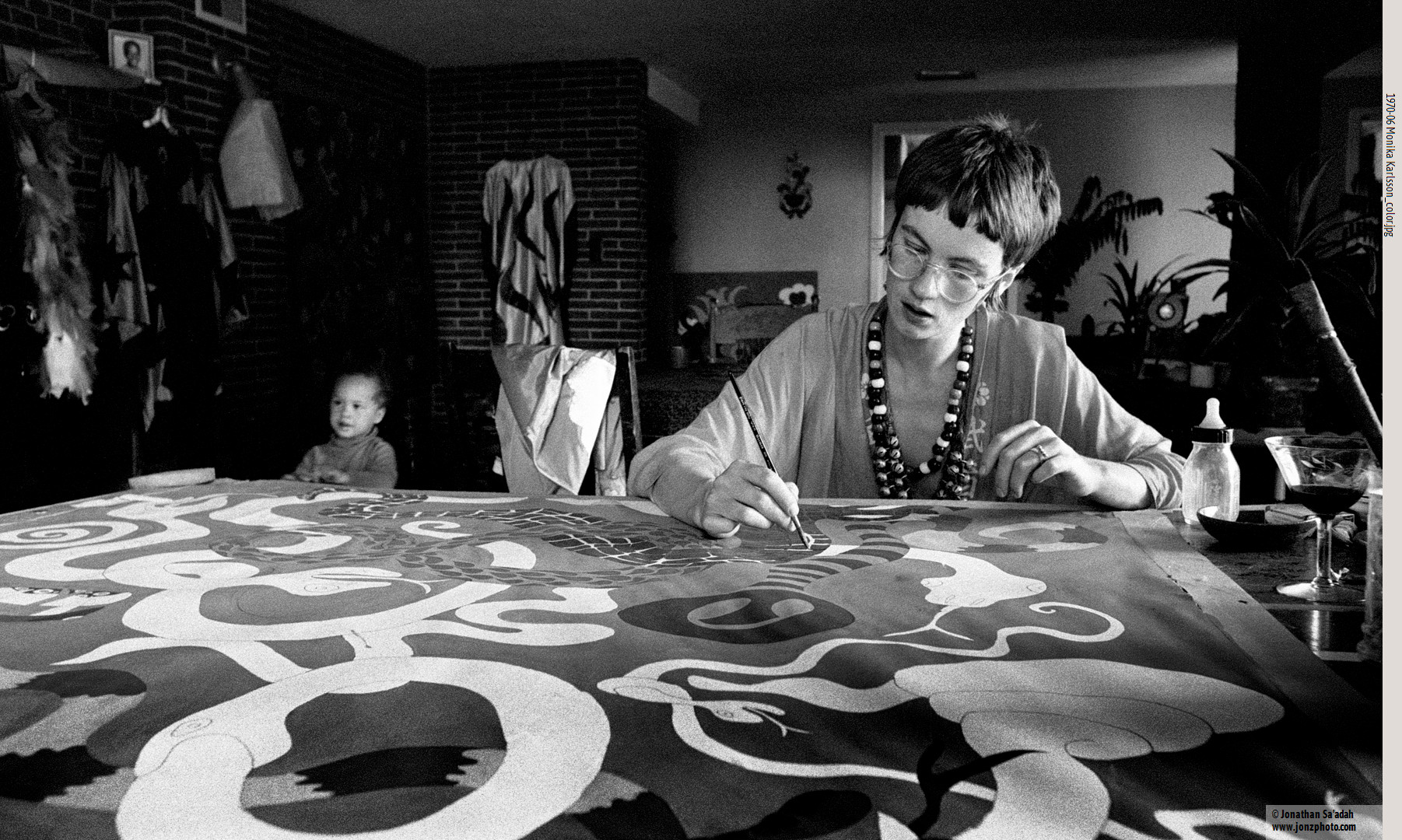
    A delicate balance Moki Karlsson surrounded by her work and family in her Post Mills, Vermont home. Every detail of this photograph represents Moki – her son Eagle-Eye, Don’s performance costumes hanging on the wall, the plants…Moki created worlds where she lived, centered around her family and her projects. (Vermont, 1970)

    Early Life and Education

    Monika Marianne Karlsson was born on February 8, 1943, in Koler, a small town in Norrbotten, Sweden’s far northern region. Her parents, Verner Karlsson and Marianne Karlsson, were from opposite ends of Sweden – her father was from Skåne in the south and her mother from Norrland in the north. Verner worked as a station master for the railway company, while Marianne ran the local post office. The family moved frequently throughout Sweden as Verner was posted to different stations.

    From an early age, Moki displayed an independent spirit and a deep connection to nature. She was absorbed by the world of animals and the natural environment, preferring to spend time in the forest rather than with other children.

    After leaving school in 1959, Moki apprenticed at the Haute Couture Atelier Anna-Greta Blom before working as a design assistant with Vera Öhrn at Distingo, a women’s coat and suit manufacturer in Kristianstad. In 1962, she moved to Stockholm to study fashion design, illustration, and pattern-cutting at Beckman’s School of Design (now Beckmans College of Design).

    Meeting Don Cherry and Early Artistic Collaboration

    In 1963, while still a student, Moki met American jazz trumpeter Don Cherry at Gyllene Cirkeln (The Golden Circle) in Stockholm, where he was performing with saxophonist Sonny Rollins. Don was already recognized as one of the leading figures in American avant-garde jazz, having been a key member an innovative quartet that shook up American jazz in 1959 (The Ornette Coleman Quartet).
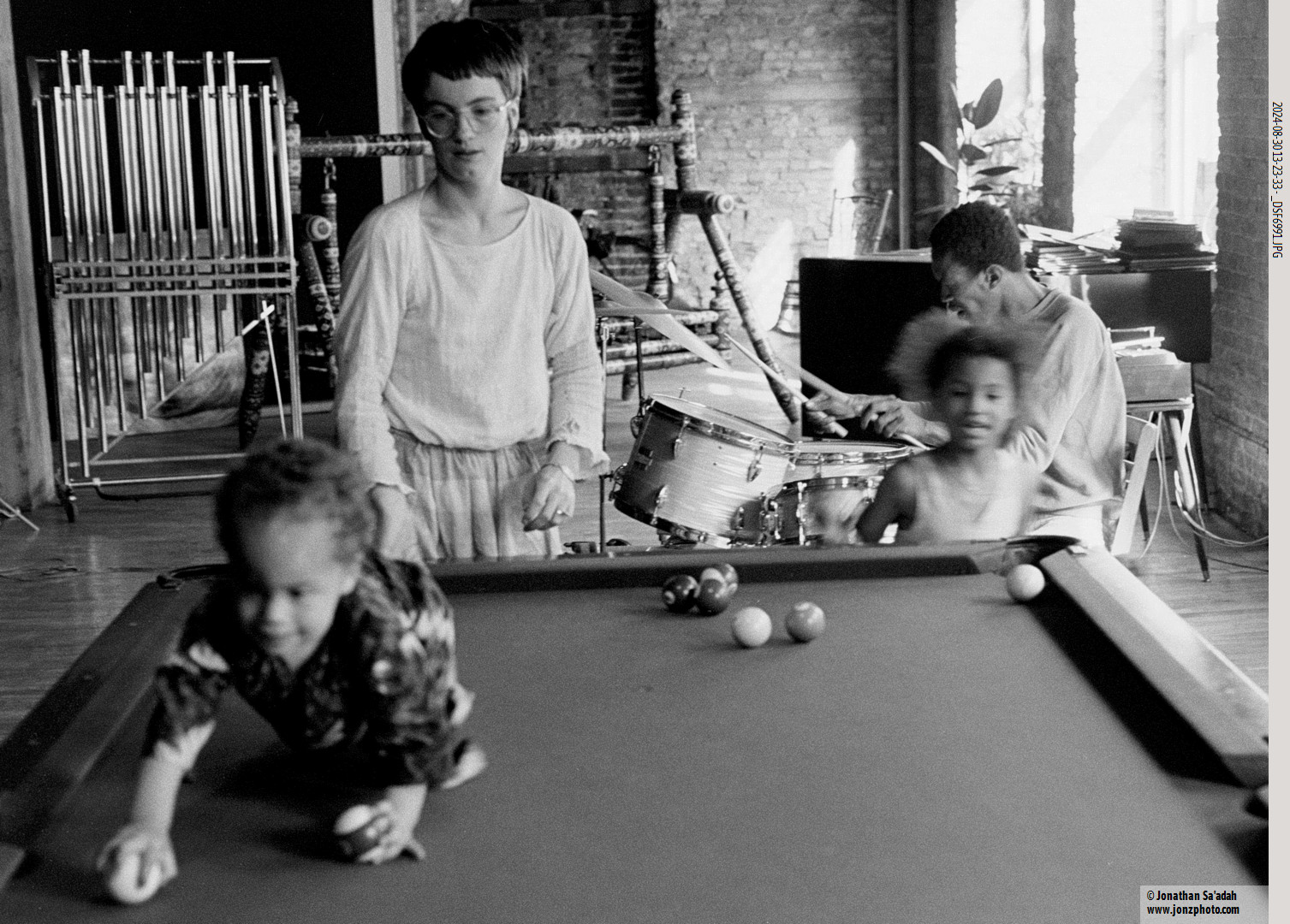
    Often multi-tasking Eagle-Eye has a clear idea of where he wants to pocket the shot (with Neneh’s encouragement). Don is practicing drums while waiting for Ornette Coleman to show up in Coleman’s Prince Street loft. (New York, 1970)

    Artistic Practice and Philosophy

    Moki’s artistic practice was inherently interdisciplinary, encompassing textiles, painting, sculpture, ceramics, collage, set design, and costume creation. Her work was characterized by bold colors, organic forms, hybrid creatures, and spiritual symbolism drawn from various cultural traditions including Indian art, Tibetan Buddhism, African aesthetics, and Scandinavian folk art.

    Textiles and Tapestries

    Moki’s textile work became her signature medium, born out of practical necessity. Living a nomadic lifestyle with Don and her family, she found that fabric was lightweight, transportable, and versatile. She could “roll it up, put it in a couple of duffel bags” and carry her studio anywhere. Her large-scale textile appliqué tapestries served multiple functions: as stage backdrops for Don’s performances, album covers, as educational tools for children’s workshops, and as independent artworks displayed in galleries.

    Major Exhibitions and Recognition

    Moderna Museet Stockholm (1971)

    One of Moki’s most significant early exhibitions was at Moderna Museet Stockholm in 1971, as part of the Utopias & Visions 1871-1981 exhibition. Pontus Hultén, the museum’s director, commissioned Don and Moki to create an installation which was housed in a Buckminster Fuller geodesic dome. Moki created artwork which defined the performance space, which was used to gather artists and musicians from Europe and beyond.

    From 1977 onward, Moki split her time between Tågarp (the family home near Malmö) and Long Island City, New York, maintaining her connection to both her Swedish roots and the international art community. She continued to exhibit regularly, with solo shows in galleries across Sweden, the United States, and Europe.
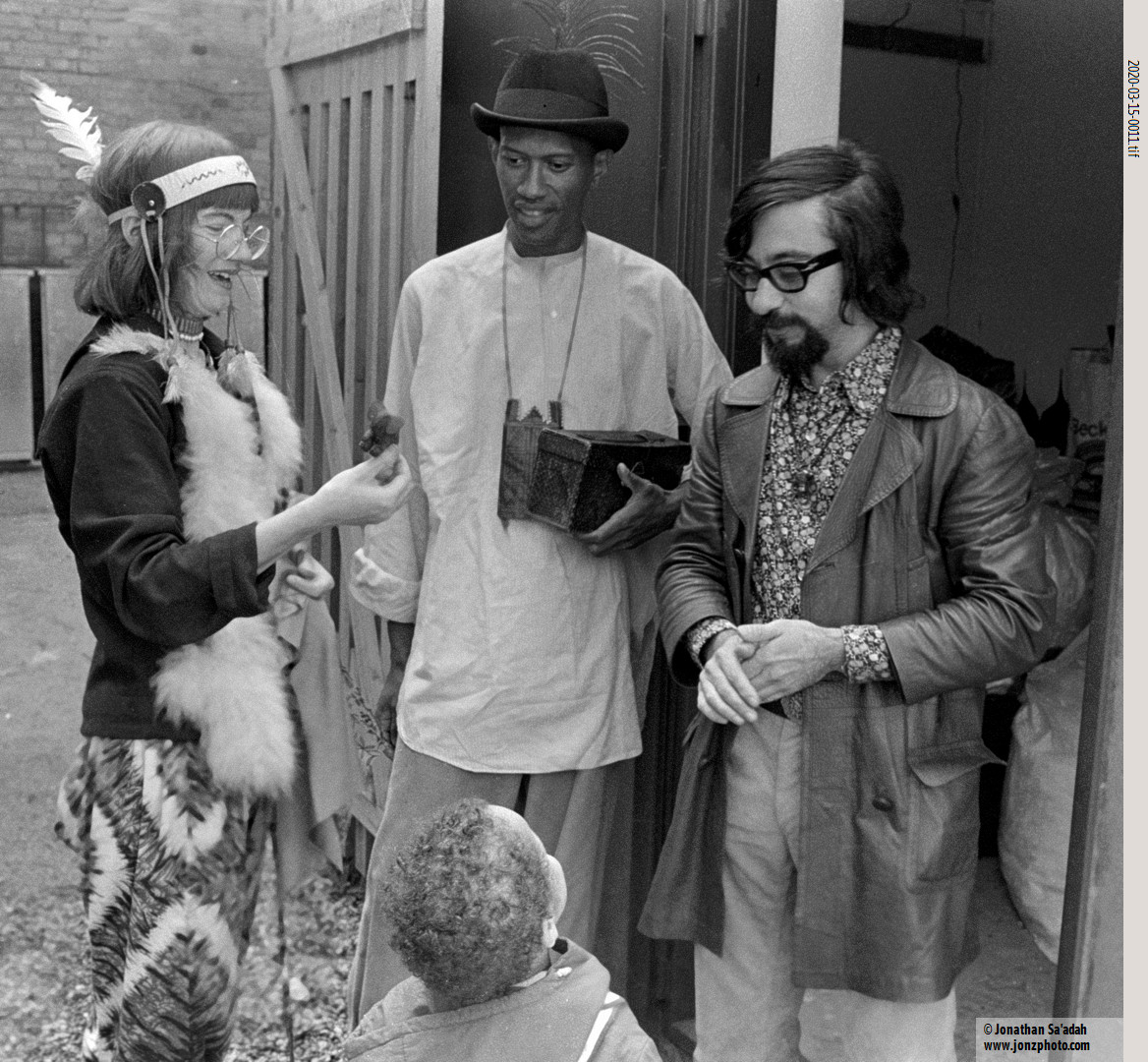
    Collaborators in Stockholm Don Cherry is holding the leather case, home to his pocket trumpet, while the Turkish percussionist Okay Temiz talks to Eagle-Eye. They are standing immediately outside the naval brig on the Stockholm island of Skeppsholmen that was used as housing for the family during the 1970 summer exposition. (Stockholm, 1971)

    Personal Life and Family

    Moki’s personal life was inextricably linked to her artistic practice. Moki successfully balanced motherhood, artistic practice, and professional collaboration. She said about the challenges: “I was my husband’s muse, companion and collaborator. At the same time, I did all the practical maintenance. I was never trained to be a female, so I survived by taking a creative attitude to daily life and chores.”

    Legacy and Rediscovery

    Moki Cherry died on August 29, 2009, in her Tågarp home. For much of her lifetime, her contributions were overshadowed by Don’s fame and the gendered biases of the art world toward textile work. However, the period following her death has seen a resurgence of interest in her work.

    Major retrospectives include Moki Cherry: A Journey Eternal at Moderna Museet Malmö (2023), the most comprehensive presentation of her work to date, and Moki Cherry: Here and Now at the Institute of Contemporary Arts, London (2023), her first solo exhibition in a UK institution.

    These exhibitions have been curated in collaboration with her granddaughter Naima Karlsson, who has become a key advocate for her grandmother’s legacy.
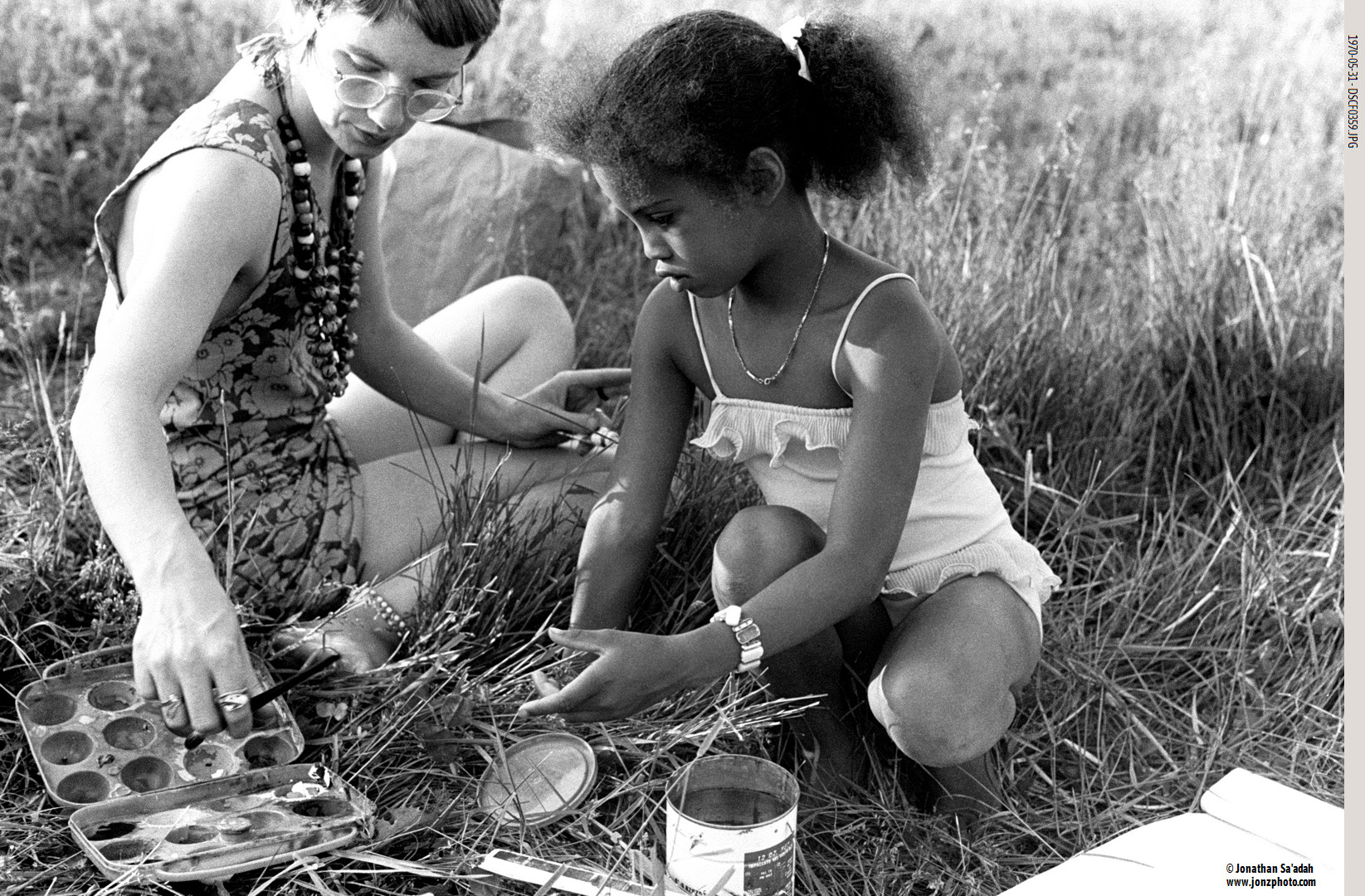
    Moki helping Neneh with color Neneh was a voracious daughter to Moki’s sensibilities which she combined with her step-father’s musical world. Both have served her well. (Vermont, 1970)

    Writing and other media about Moki’s work and life

    Moki’s work abounded in color. These articles and web pages have reproductions which often do justice to her chromatic sensibilities.

    Adesina, Precious. “Moki Cherry: The Overlooked Swedish Artist Who Created a ‘Soulful Home,’” January 1, 2024. https://www.bbc.com/culture/article/20231222-moki-cherry-the-overlooked-swedish-artist-who-created-a-soulful-home.
    Carsel, Casey. “Moki Cherry’s Art and Life Remembered,” September 29, 2021. https://ocula.com/magazine/spotlights/moki-cherrys-art-and-life-remembered/.
    Compton, Gemma. “Moki Cherry – Here and Now. – Blog.” Gemma Compton, February 6, 2024. https://www.gemmacompton.com/blog/2024/2/6/moki-cherry-here-and-now.
    Denman, Tom. “Moki Cherry at the Juncture of Art and Life.” ArtReview, August 22, 2023. https://artreview.com/moki-cherry-at-the-juncture-of-art-and-life/.
    “Don and Moki Cherry’s Organic Dreams Made Real.” National Public Radio, June 18, 2021. https://www.npr.org/2021/06/18/1007252382/don-cherry-and-moki-cherry-organic-music-society.
    “Don Cherry — Brown Rice (LP, Brown Vinyl) — Soundohm.” https://www.soundohm.com/product/brown-rice-lp-brown-vinyl.
    E-flux. “Don and Moki Cherry: Organic Music Societies, Alexander Kluge: Minutenfilme #3 – Announcements,” February 8, 2022. https://www.e-flux.com/announcements/438577/don-and-moki-cherryorganic-music-societiesalexander-kluge-minutenfilme-3.
    E-flux. “Moki Cherry: A Journey Eternal – Announcements.” https://www.e-flux.com/announcements/557927/moki-cherrya-journey-eternal.
    Krasinkski, Jennifer. “Krasinski_Artforum_Cherry.” ArtForum, June 1, 2021. https://www.blankforms.org/sites/default/files/2022-07/Krasinski_Artforum_Cherry.pdf.
    Larsen, Lars Bang. “Moki Cherry Exhibit at Galleri Nicolia Wallner, Copenhagen.” Nicolai Wallner (blog), April 7, 2022. https://nicolaiwallner.com/exhibition/moki-cherry-2/.
    Moderna Museet I Malmö. “A Journey Eternal.” https://www.modernamuseet.se/malmo/en/exhibitions/moki-cherry/a-journey-eternal/.
    Moderna Museet I Malmö. “From Norrbotten to New York.” https://www.modernamuseet.se/malmo/en/exhibitions/moki-cherry/from-norrbotten-to-new-york/.
    Mokicherry.com. “About Moki Cherry.” https://mokicherry.com/about.
    Mokicherry.com. “Moki Cherry Exhibitions.” https://mokicherry.com/exhibitions.
    Neneh Cherry, Naima Karlsson + More on Moki Cherry’s Life, Love and Work as an Artist and Mother | ICA Infrequencies, 2023. https://shows.acast.com/ica-infrequencies/episodes/moki-cherry-home-as-stage-stage-as-home.
    NOBA Nordic Baltic Contemporary Art Platform. “Moki Cherry Exhibit in Malmö.” https://noba.ac/en/exhibition/moki-cherry.
    Psimikakis-Chalkokondylis, Laonikos. “Imagine! Play! Learn! – By Evie Ward.” Sound and Music (blog), August 31, 2022. https://soundandmusic.org/post/imagine-play-learn-by-evie-ward/.
    Reeves, Chris. “A Praxis of Art and Life: A Review of Moki Cherry at Corbett vs. Dempsey | Newcity Art a Praxis of Art and Life: A Review of Moki Cherry at Corbett vs. Dempsey,” September 15, 2021. https://art.newcity.com/2021/09/15/a-praxis-of-art-and-life-a-review-of-moki-cherry-at-corbett-vs-dempsey/.
    Russonello, Giovanni. “A Fresh Look at the ‘Organic Music’ of Moki and Don Cherry..” Jordan News, April 30, 2021. https://www.jordannews.jo/Section-117/Culture-Arts/A-fresh-look-at-the-organic-music-of-Moki-and-Don-cherry-2283.
    Snoekx, Kurt. “Home Is Where the (He)Art Is: Argos Revisits Don & Moki Cherry’s Organic Music Society,” December 2, 2022. https://www.bruzz.be/en/culture/art-books/home-where-heart-argos-revisits-don-moki-cherrys-organic-music-society-2022-02-11.
    Tolhurst, Sophie. “Rediscovering Swedish Designer and Artist Moki Cherry.” Design Week, June 9, 2023. https://www.designweek.co.uk/issues/05-june-09-june-2023/swedish-designer-artist-moki-cherry/.
    Walton, Millie. “Burlington Contemporary – Reviews,” August 23, 2023. https://contemporary.burlington.org.uk/reviews/reviews/moki-cherry-here-and-now.
    Ward, Evie. “Mobile Aesthetic Environments.” Moderna Museet I Malmö. https://www.modernamuseet.se/malmo/en/exhibitions/moki-cherry/mobile-aesthetic-environments/.
  • Laughter in the shadows: The chilling cabaret scene of M Klein

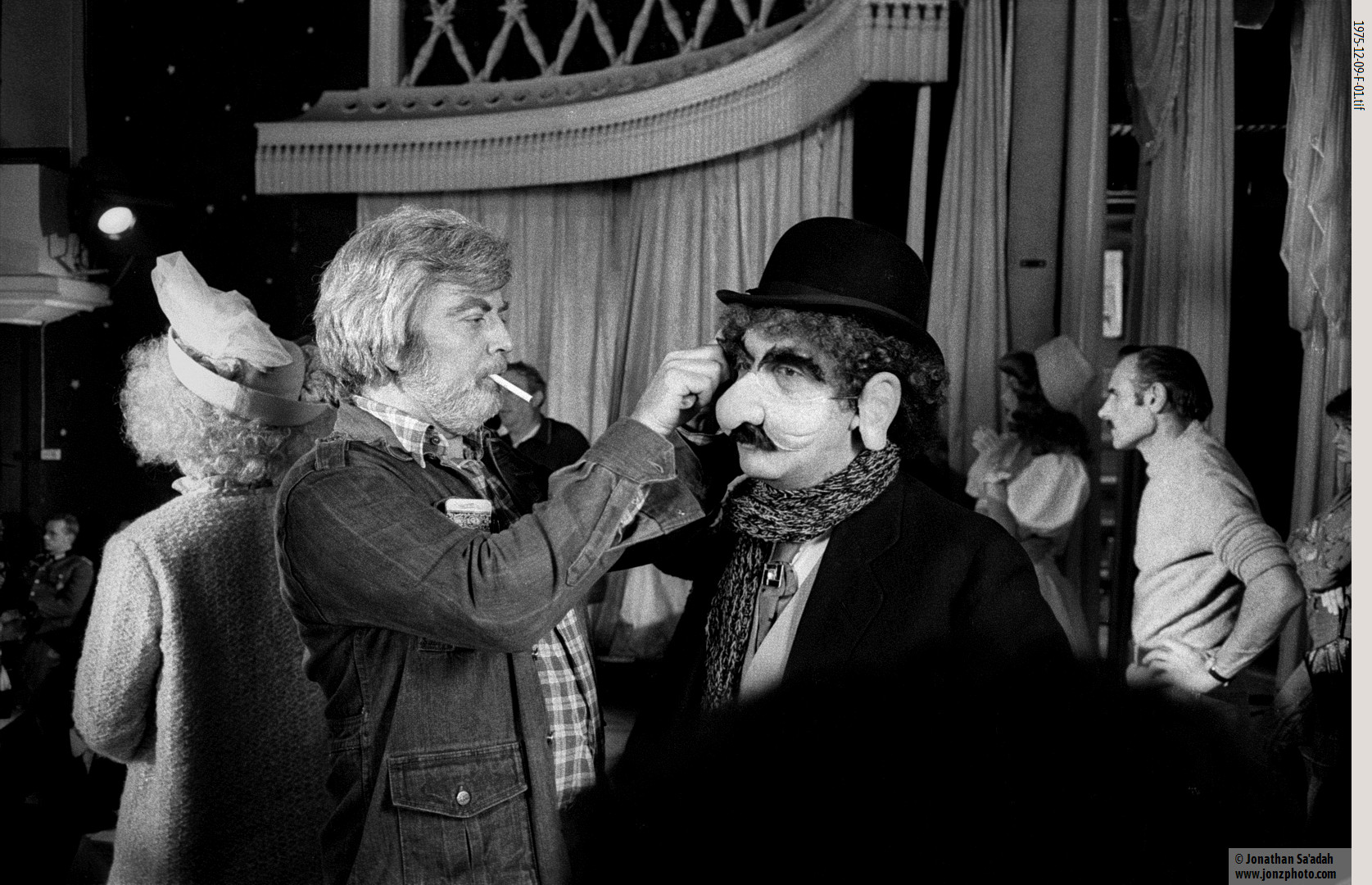
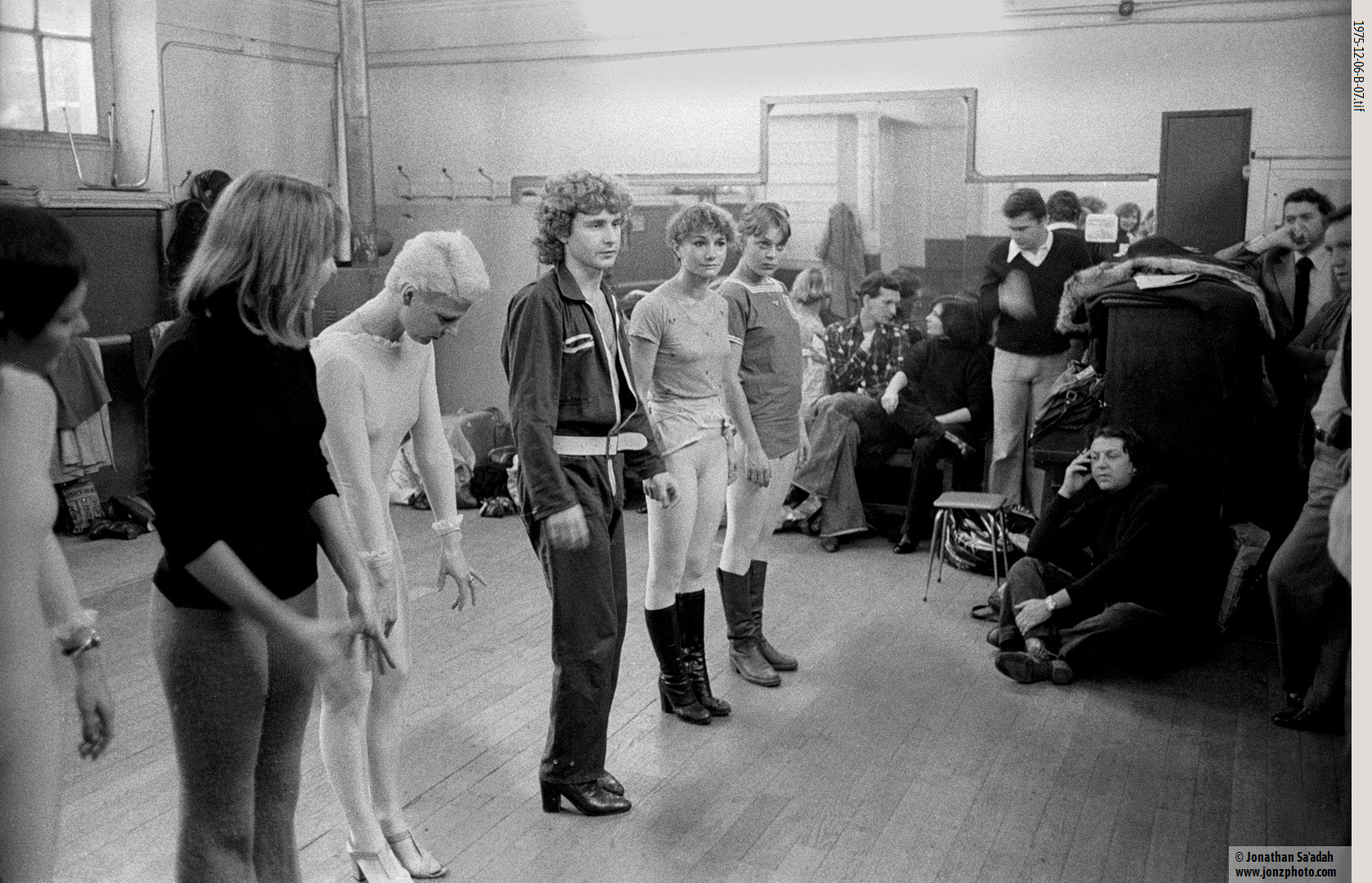
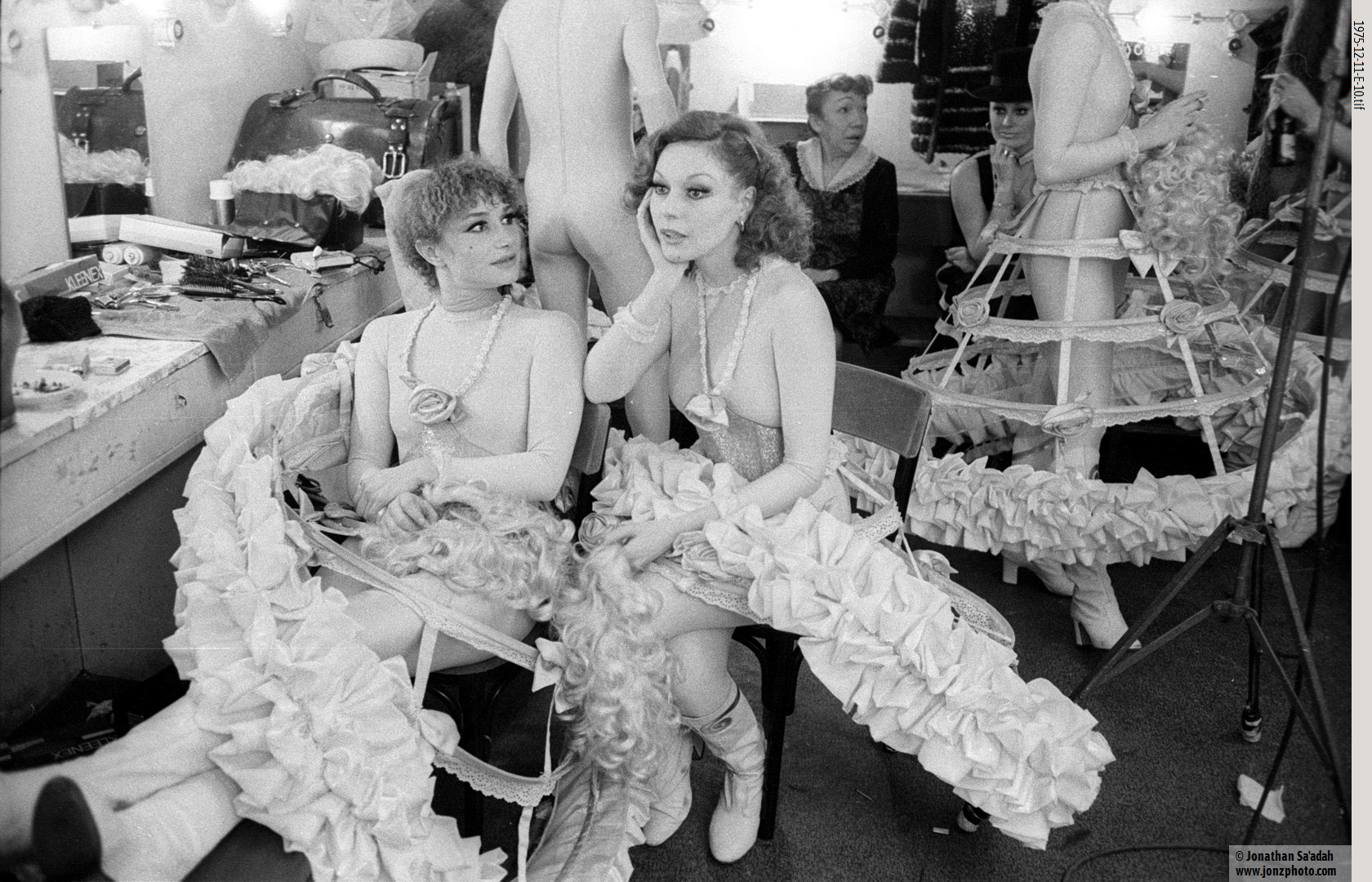
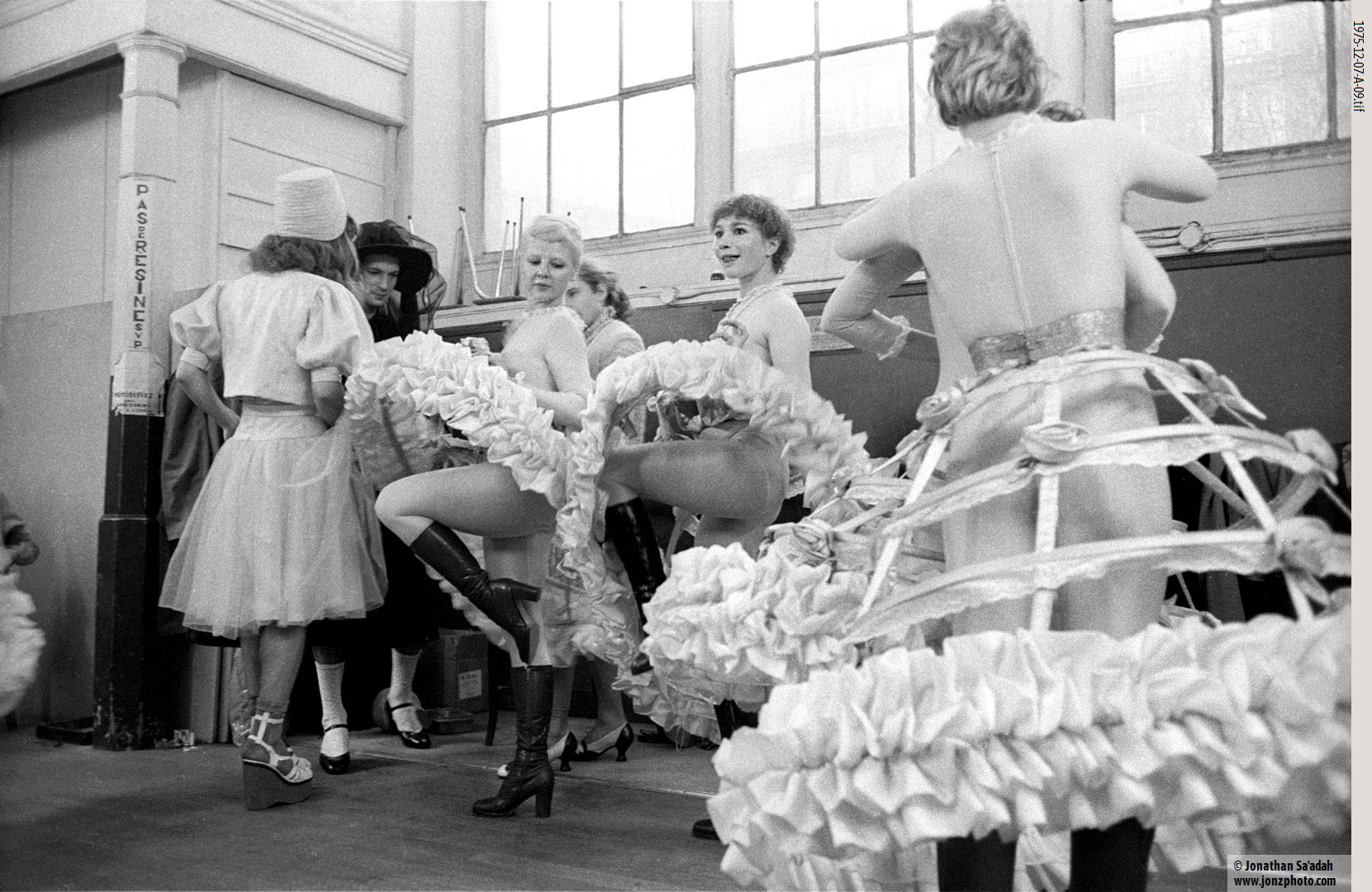
    ▲ In the final shot of the cabaret scene, a chorus line of dancing girls in hoop skirts kick their way out onto the stage. These women were practicing dancing with the hoops, which was an acquired skill.

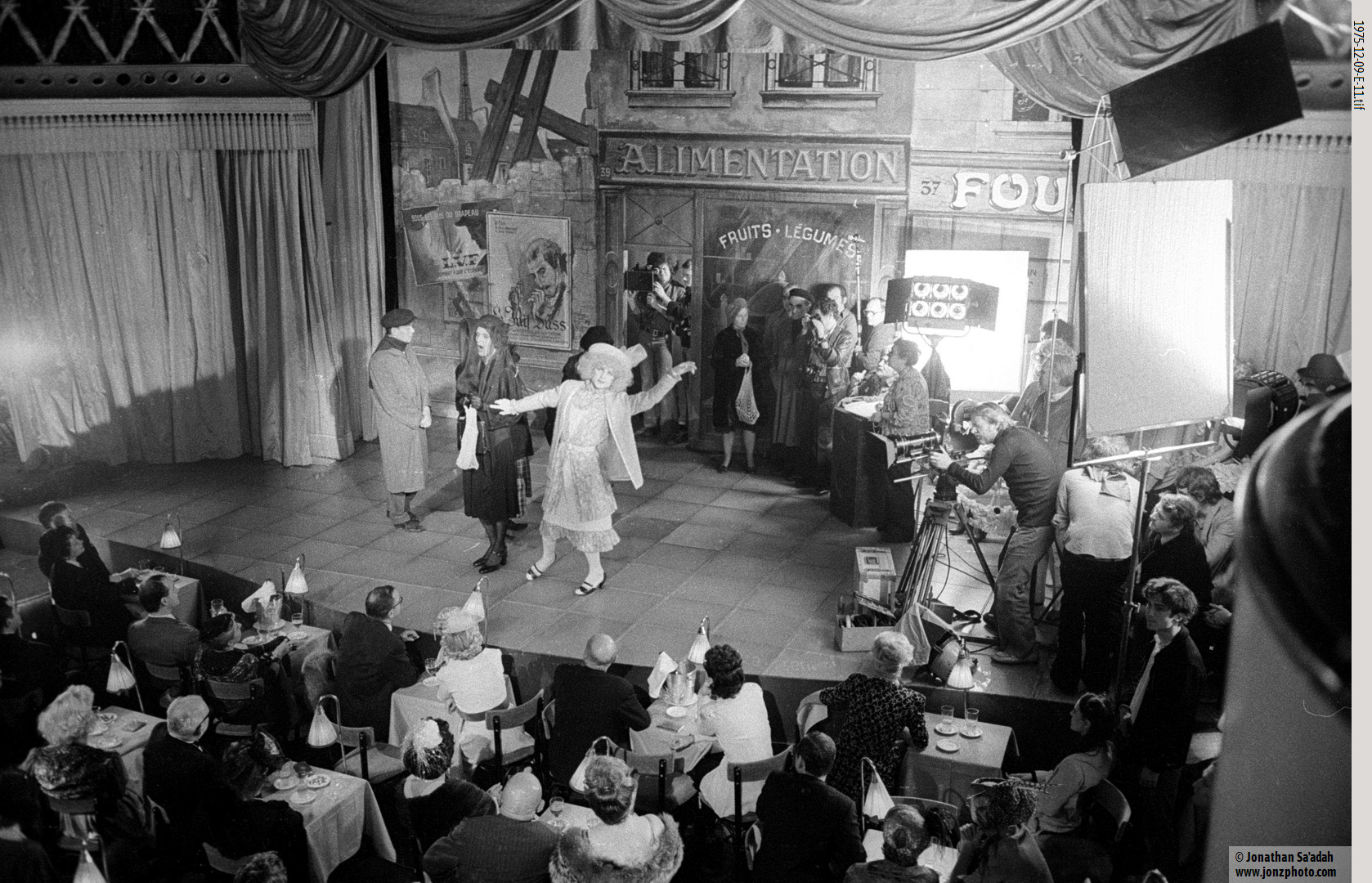
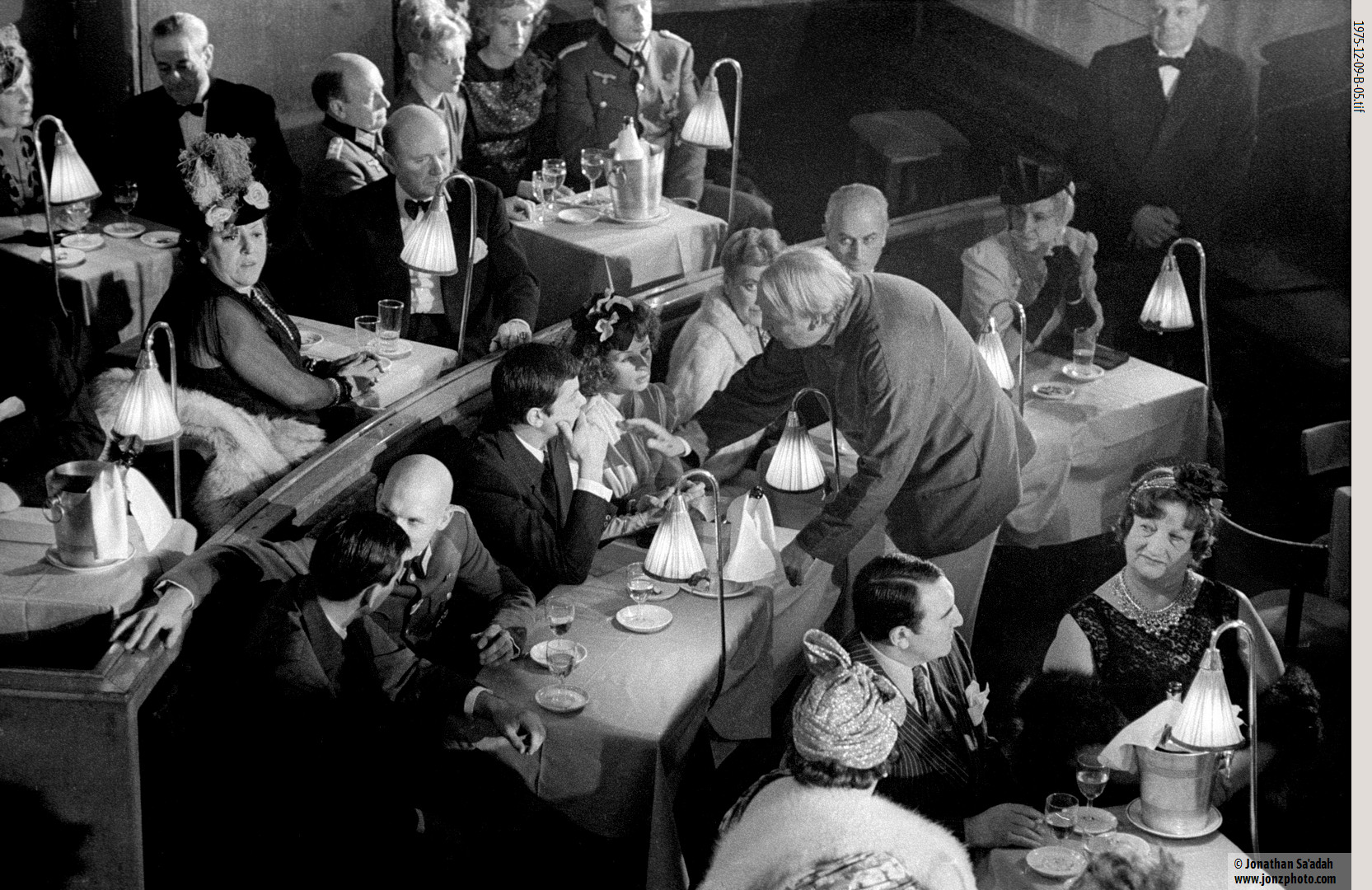
    The cabaret scene in Joseph Losey’s M Klein, which occupies a full five minutes in the film, is the pivotal scene in the movie – when Klein first wakes up (with some prodding from his girlfriend) and realizes that the racist skit that he and others are mindlessly applauding in a WWII Paris cabaret is actually insulting, repulsive and sinister. The scene was drawn out as a sketch in the original screenplay but was developed in detail as Losey worked with the cabaret artist Frantz Salieri to bring into focus the violent hatred that underpins the action in this scene and the film overall. Losey created an audience of predatory scavengers to applaud and dine while watching the anti-Semitic stage show.

    Joseph Losey directing actors

    Losey Salieri collaboration
    Frantz Salieri was given the role by Joseph Losey of creating the stage show component in the film’s cabaret scene. Salieri, a multi-discipline artist working under a variety of names (Francis Savel as a painter, Dietrich de Velsa as film director), later collaborated with Losey on the film Don Giovanni. As a painter (Francis Savel) he had been the subject of an 18 minute documentary portrait (“Le Journal d’un Combat, Guy Gilles, 1964) which captured his painting process and, interestingly enough, was narrated by Alain Delon. A later work under the Dietrich de Velsa identity was his 1980 film, Équation à un inconnu (Equation to an Unknown), which was an erotic rendering of queer culture in France in the period preceding AIDS and was distinguished by his directorial vision.

    Several years prior to the filming of M Klein Salieri created a Parisian transvestite cabaret show called “La Grande Eugène”, which performed on rue de Marignan in the 8th arrondissement in Paris and was known for its flamboyance and innovative theatrical staging. Salieri created a show that represented a radical departure from what was offered in the traditional Parisian entertainment venues, featuring transformiste performances with elaborate drag shows and sophisticated theatrical presentations. The show was the subject of a David Bailey photo essay published in London Sunday Times in 1973. The cast of “La Grande Eugène” was used as the mainstay for the cabaret show in M Klein. It’s likely that Losey had learned of Salieri’s work from the 1973 run of “La Grande Eugène” in London, and that’s what led to the connection and his collaboration in this film.[1] Losey, throughout his life, was always on the lookout for talented artists whose work he perhaps could incorporate in his film projects. Examples I knew of personally were Salieri, who he used, and also Pilobolus,[2] and jazz musician Don Cherry, both of whom he never collaborated with but followed closely.

    Losey’s concerns and background in theatrical production
    In approaching the scene Losey concern was in creating content that might be attractive to racists. This concern arose because of a previous incident at La Cinémathèque française in Paris where a film festival screening wartime films had to be closed down because the anti-Semitic content attracted an audience looking for and cheering along what was shown. His goal was to find a way to stage the cabaret show in a manner that wouldn’t appeal to racists, and by using male actors to play the female roles, he was brilliantly successful in turning off racist interest.[3]

    In the script Klein tries to track down the other Klein, and in the course of this search goes looking for “Isabelle”, who he thinks is the second Klein’s girlfriend. This leads him first to the cabaret show being staged in the Parisian cabaret “La Nouvelle Eve”, and then to the stage entrance where he bribes the concierge to let him question one of the dancers. After questioning the dancer (Lola) she says that “Isabelle” is really “Cathy” and and that she doesn’t work at the Cabaret any more, but rather in a munitions factory near Metro Ballard.

    Losey was adept at actual theatrical stage managing, with many credits during his American career. He was, for example, the stage managing the 1946 Academy Awards, so he knew how to create dynamic flow and excitement. He was good at timing pieces to come together and create energy, and he worked with Salieri to that end.

    But there were challenges to the shooting at La Nouvelle Eve.

    Issues in working on location
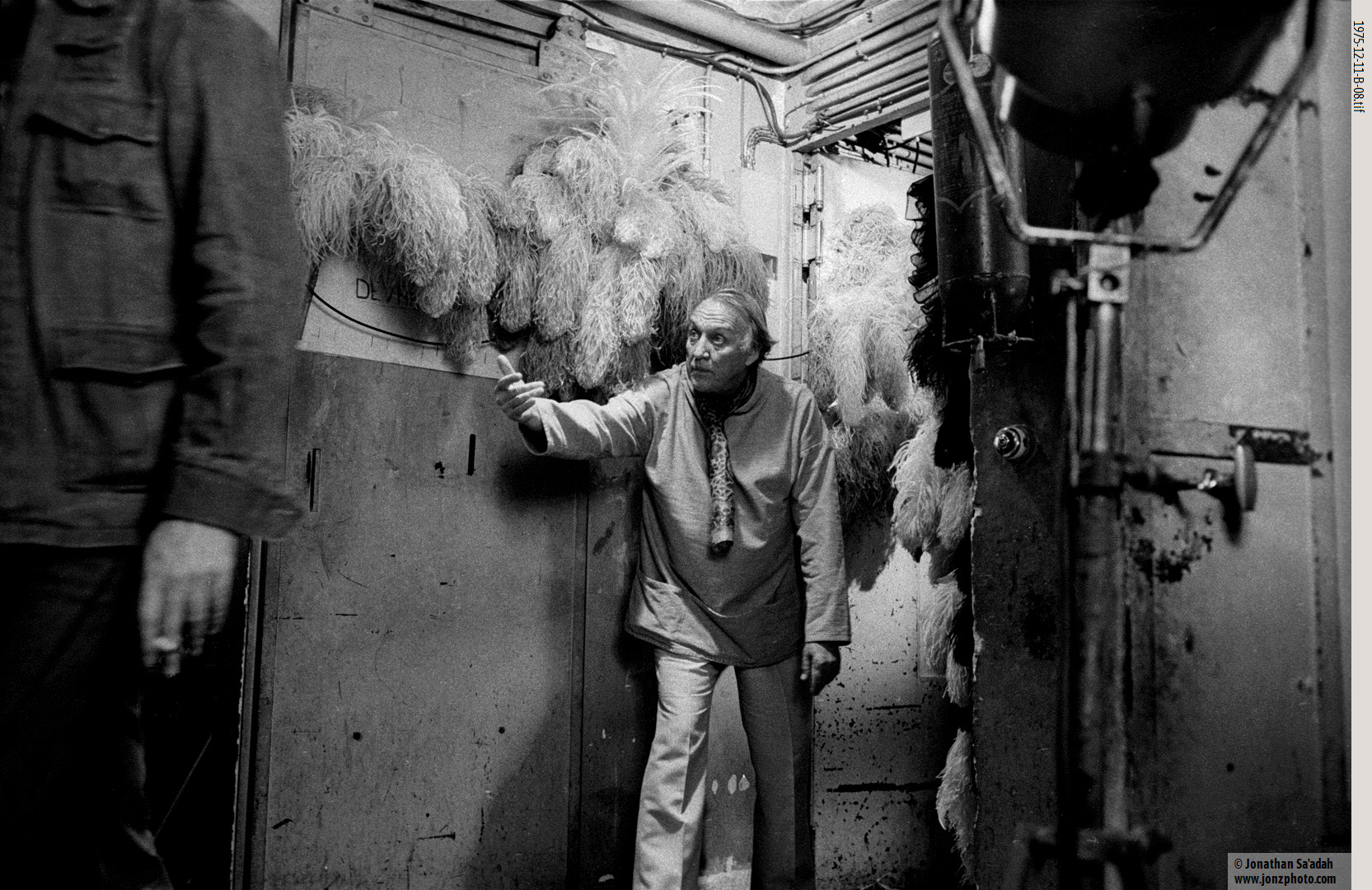
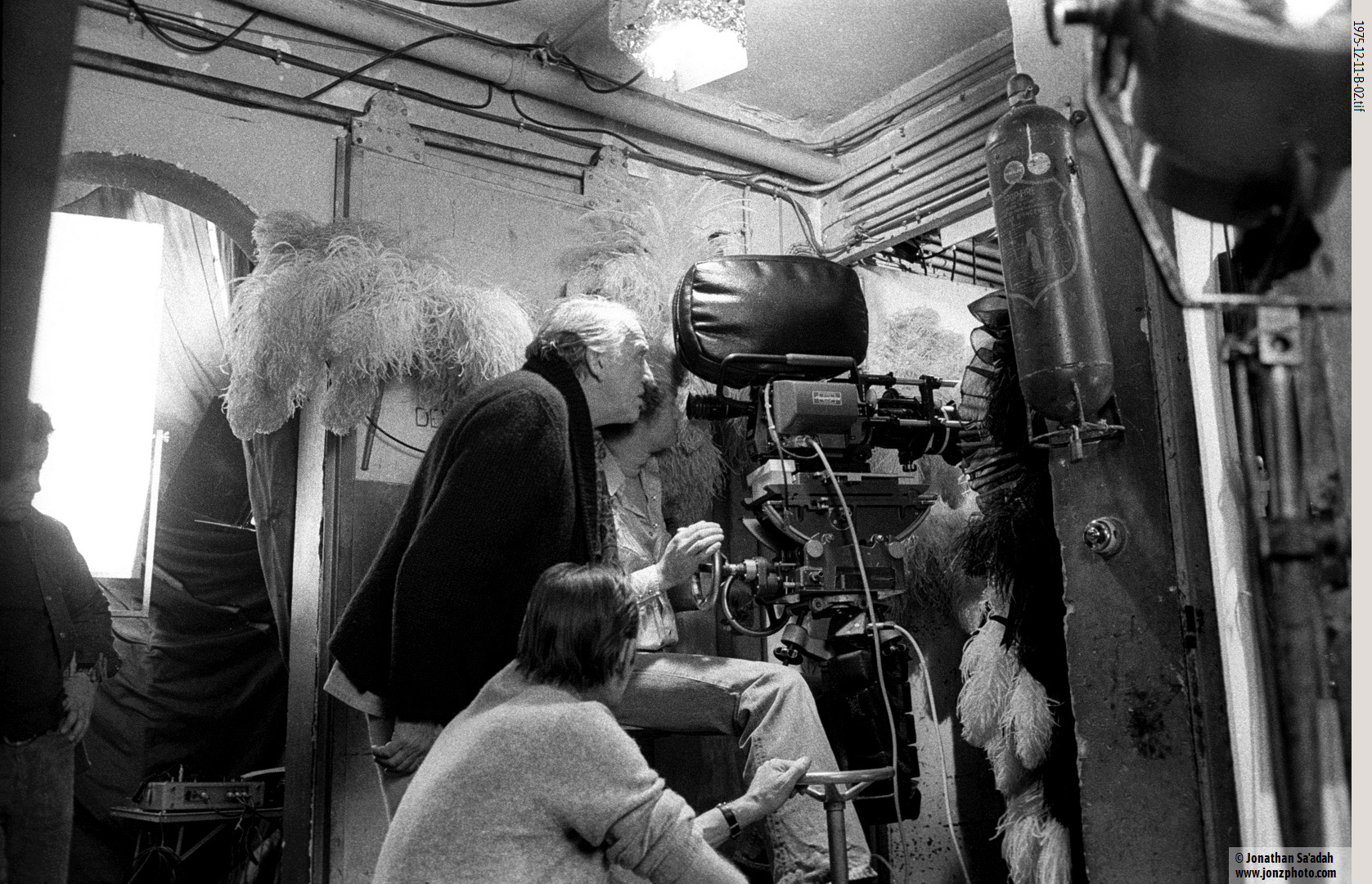
    It was technically difficult to work in the cramped, narrow corridors of the location. As a result cinematographer used the 35 mm camera both shoulder-held and on a crab dolly, both of which were difficult and took a lot of skill and strength under these conditions. Klein is first seen questioning the concierge. The camera is on a hydraulic stand (shown in the photographs) for that shot, but then is shoulder-held in the stairwell, and all the shots flowed together seamlessly. Gerry Fisher, the Cinematographer, had set up the lighting to work with almost no space.

    The two sequences that make up the cabaret scene were shot first for the stage show in the cabaret La Nouvelle Eve on December 9th and 10th, and then the stage entrance scene was filmed at the same location on December 11th.

    The results of the Salieri-Losey collaboration show camera and actor movement tied together skillfully. The result was the creation of the two memorable central scenes in the movie.

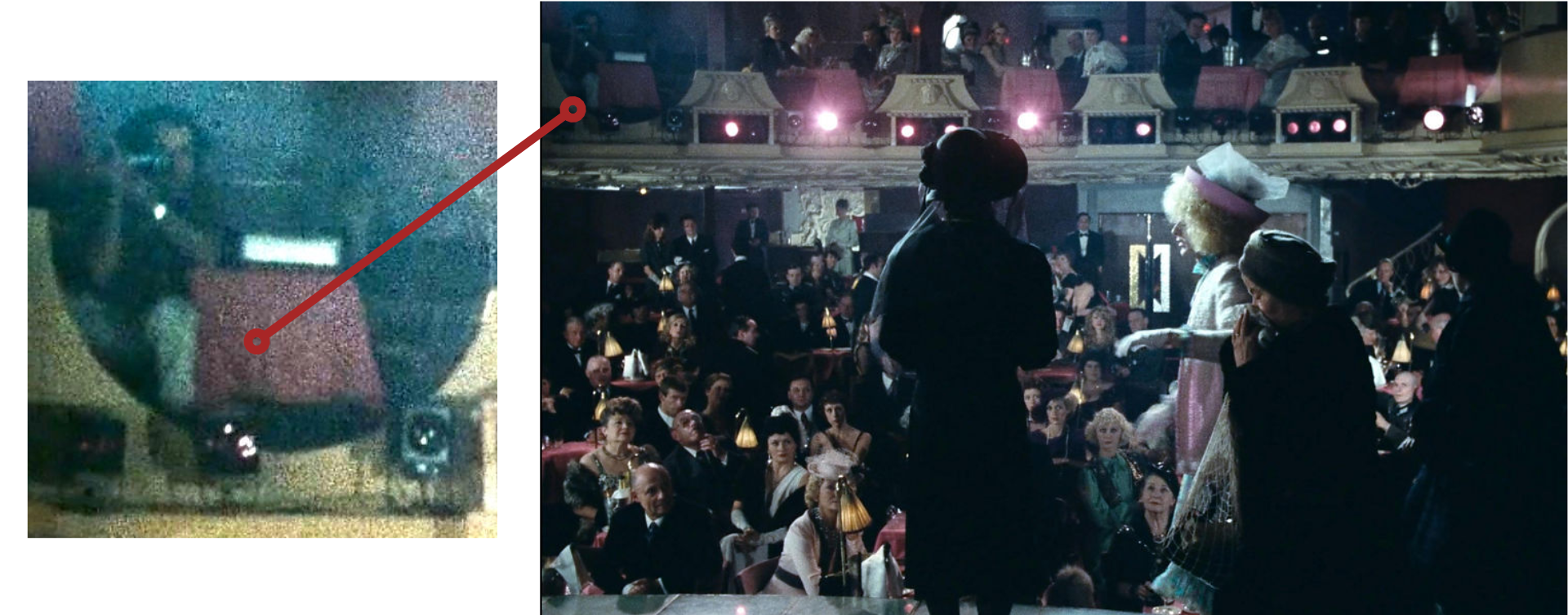
    It’s also my only ever appearance in a feature movie. I was actually at my perch taking the photo above and got through editing unnoticed. It’s the third shot of the cabaret performance sequence (2:03:27).

    Frame © Lira Films – Nova Films

    Other related posts:
    Joseph Losey’s film M Klein: A behind-the-scenes look
    Exploring location shooting in Joseph Losey’s M Klein
    Homage to Margot Capelier, Casting Director
    Sign up to get future posts on M Klein and other subjects …

    [1] Le Monde. 1986. Frantz Salieri, May 3, 1986.

    [2] Salieri’s conceptions and imaginative costume design were more radically stylized but recalled for me the costumes Pilobolus used (for instance, the “Tall Ladies” in the dance “Untitled”) in the same period.

    [3] Losey, Joseph, and Michel Ciment. 1985. Conversations with Losey. London ; New York: Methuen. Pages 347-348.

  • Exploring location shooting in Joseph Losey’s M Klein

    Previous post about Joseph Losey and the film M Klein: A behind-the-scenes introduction to M Klein

    The use of Paris locations in the shooting of Joseph Losey’s M Klein

    Location shooting is always a hassle. Some locations, like the abandoned factory or iconic city park, are well known and repeatedly used by films. But often film locations hide under the surface of everyday life, requiring intimate knowledge of the city to pull them out. Joseph Losey never lived in Paris but was determined to use locations in the filming of M Klein, eschewing the safe confines of the film studio for the realism of the buildings and streets of Paris. Finding those locations rested on the shoulders of the Art Director, Alexandre Trauner. Trauner presented Losey with potential locations and if Losey approved the responsibility of permitting and other business arrangements were handled by the production company.

    Joseph Losey
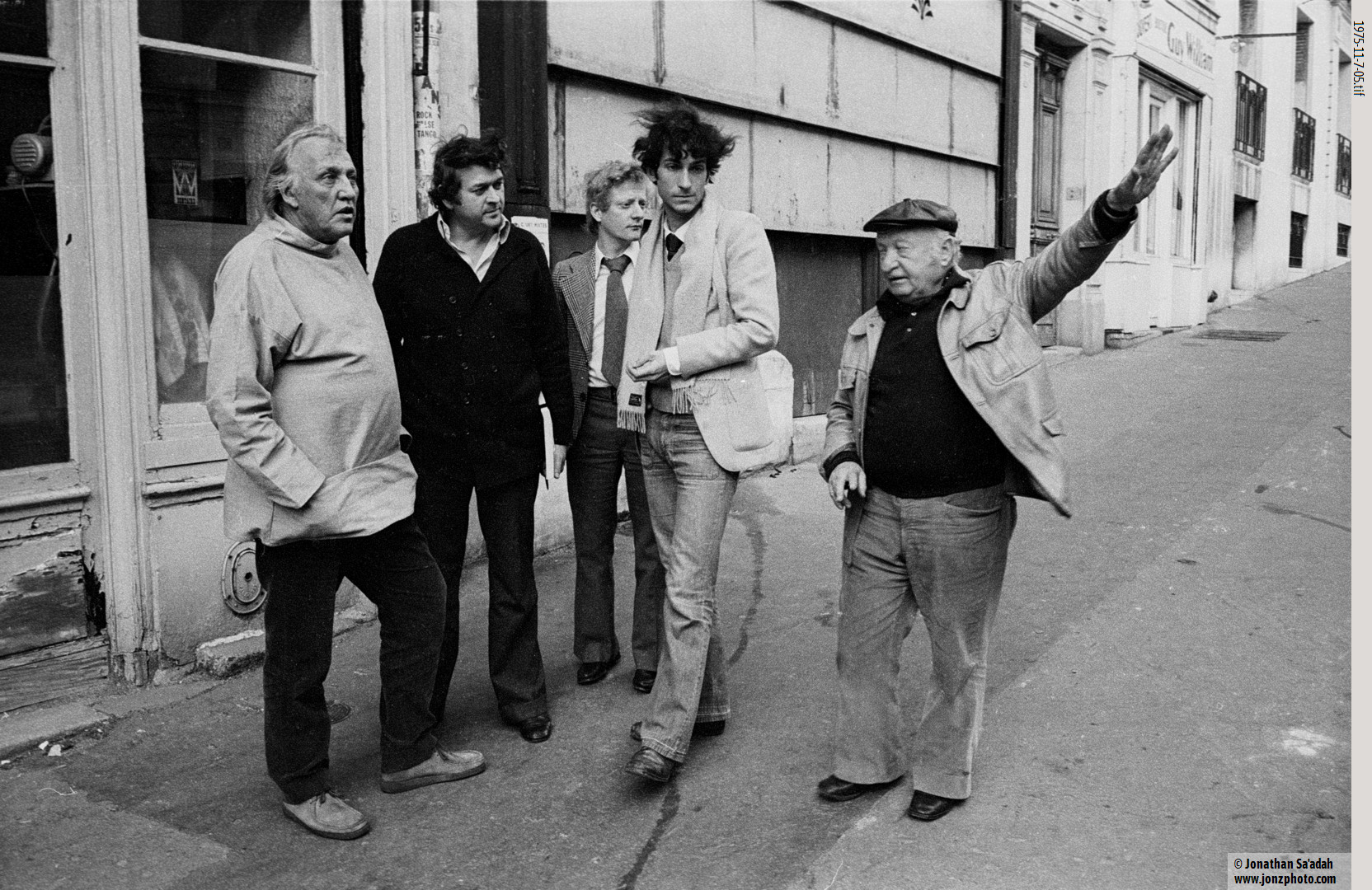
    ▲ Losey scouting a location which was later used on an early morning, with police wagons picking up Jews from their homes. In the middle are three assistant directors and the man on the right is Alexandre Trauner, the Art Director.

    Though he experienced push-back from the production company related to the increased cost and logistical complexity, Losey prevailed, using thirty two locations for the shooting in M Klein. These locations admittedly increased production headaches but added greater realism to the film. Location shooting also kept everyone sharp since each day would throw unpredictable challenges at the crew, most of whom were experienced professionals who liked rising to the challenge.

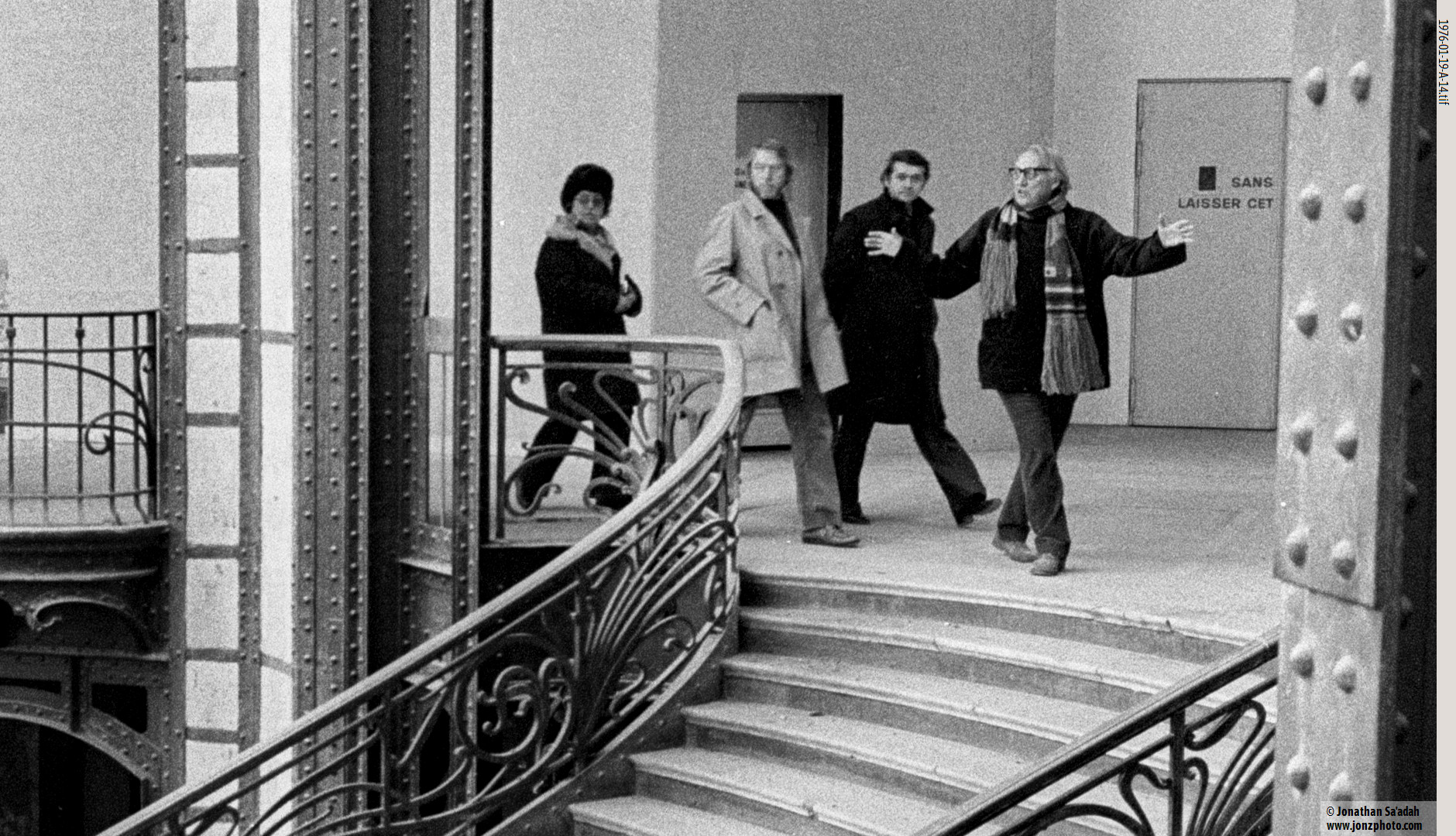
    ▲ The Grand Palais in Paris was used as one of the police collection points in the movie. Losey is explaining how he wants the framing to Gerry Fisher (in the light colored coat), Director of Photography.

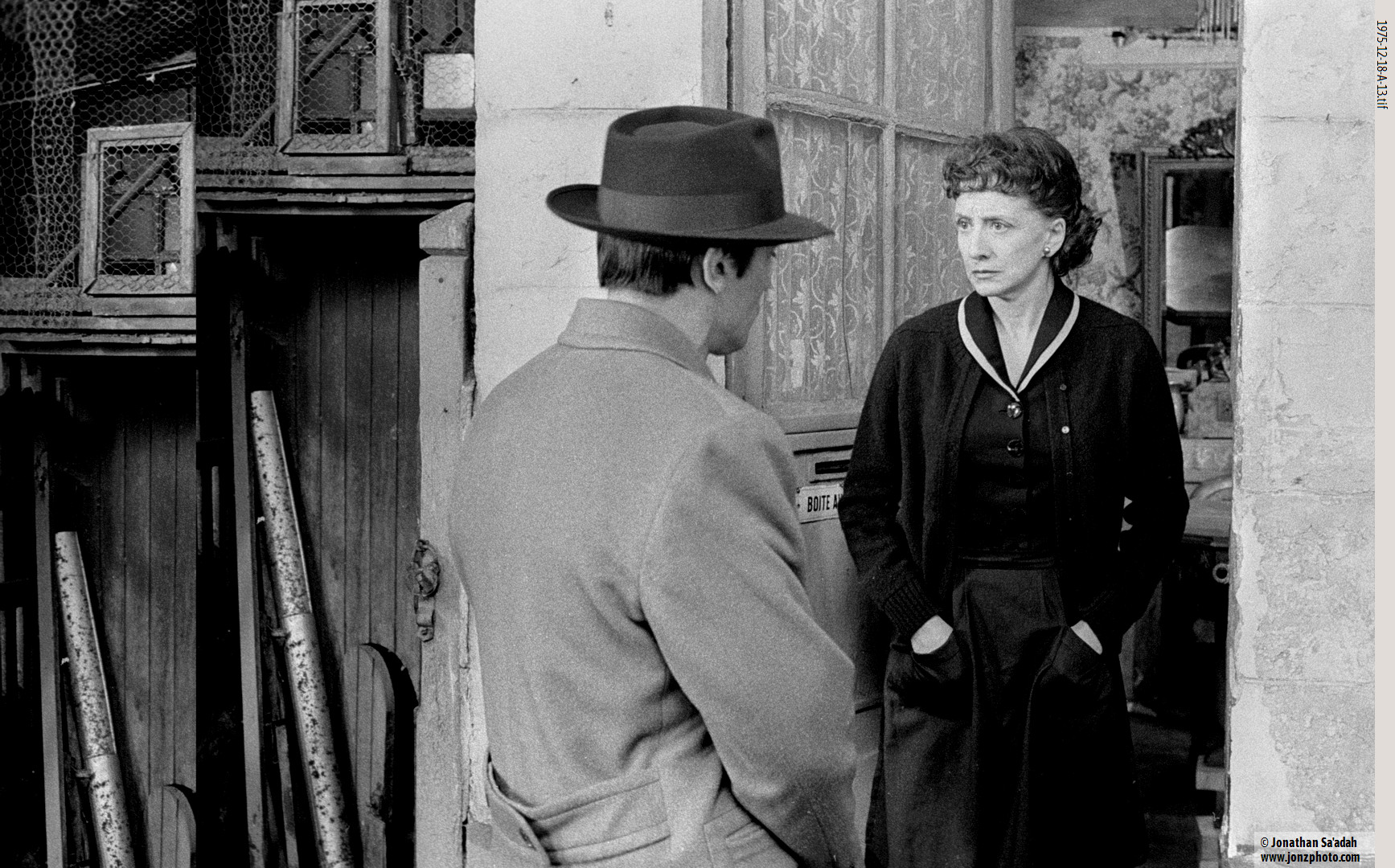
    The second Klein’s apartment was a good example. The location was at 42 rue des Panoyaux and has long since been replaced by apartment buildings. The exterior courtyard was used for the scene (“Concierge loge”) where the French Klein is looking for his double and he questions the concierge. The same location is used immediately afterwards in the film for the interior shots where the concierge allows the French Klein to inspect the Jewish Klein’s abandoned apartment. There was something sublimely ironic about famous movie stars and a well-known director having to work in filthy spaces only the poorest people would know.

    ▲ Nobody dreams up this level of realism, and it’s why location shooting wins out over studios. The doorway is inside the courtyard at 42 rue des Panoyaux where the concierge is angrily resisting being grilled by Klein.

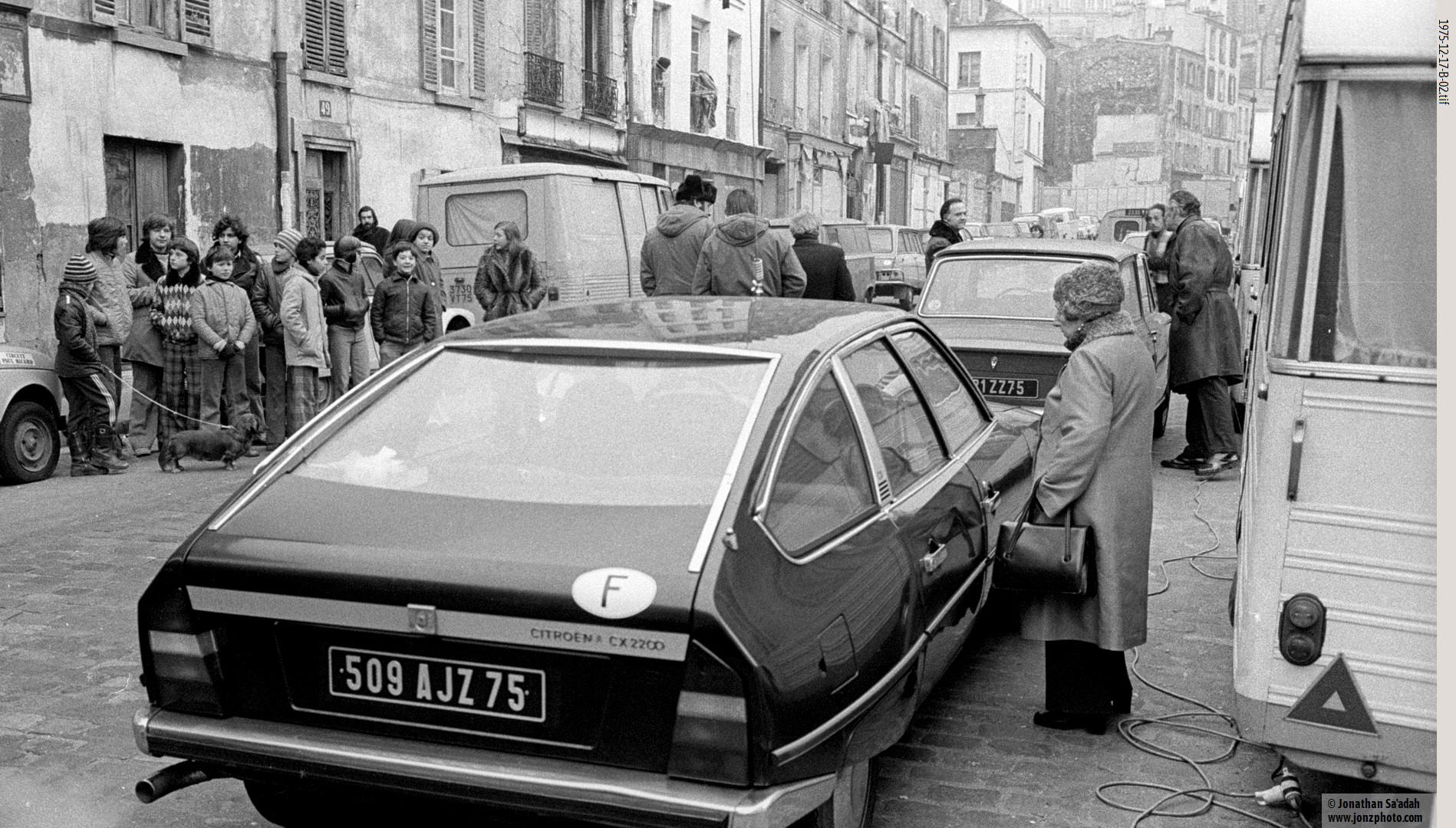
    As an illustration of location challenges, even arranging for the use of this building was complicated. The production company had to negotiate a shooting permit from the city government and a condition attached to the permit required extensive shoring of the building before the film crew would be let in, so there were significant costs in engineering and construction. Once everyone had jumped through the hoops, the actual filming required a complicated location setup. There was staff outside on the street managing the crowd of people who gathered hoping to catch a glimpse of Alain Delon, generator trucks with long cables supplying power, and intricate lighting setups because of cramped quarters. The camera crew didn’t have room to assemble their gear so that had to be done down the street at another address.

    ▲ Alain Delon’s sleek Citroën has just pulled up on the rundown street used for the second Klein apartment and Mme Ludmilla Goulian (Production Manager) is standing at his window. The group of locals are about to get a glimpse of their star. The three men with backs turned in the middle of the street are bodyguards for Delon.

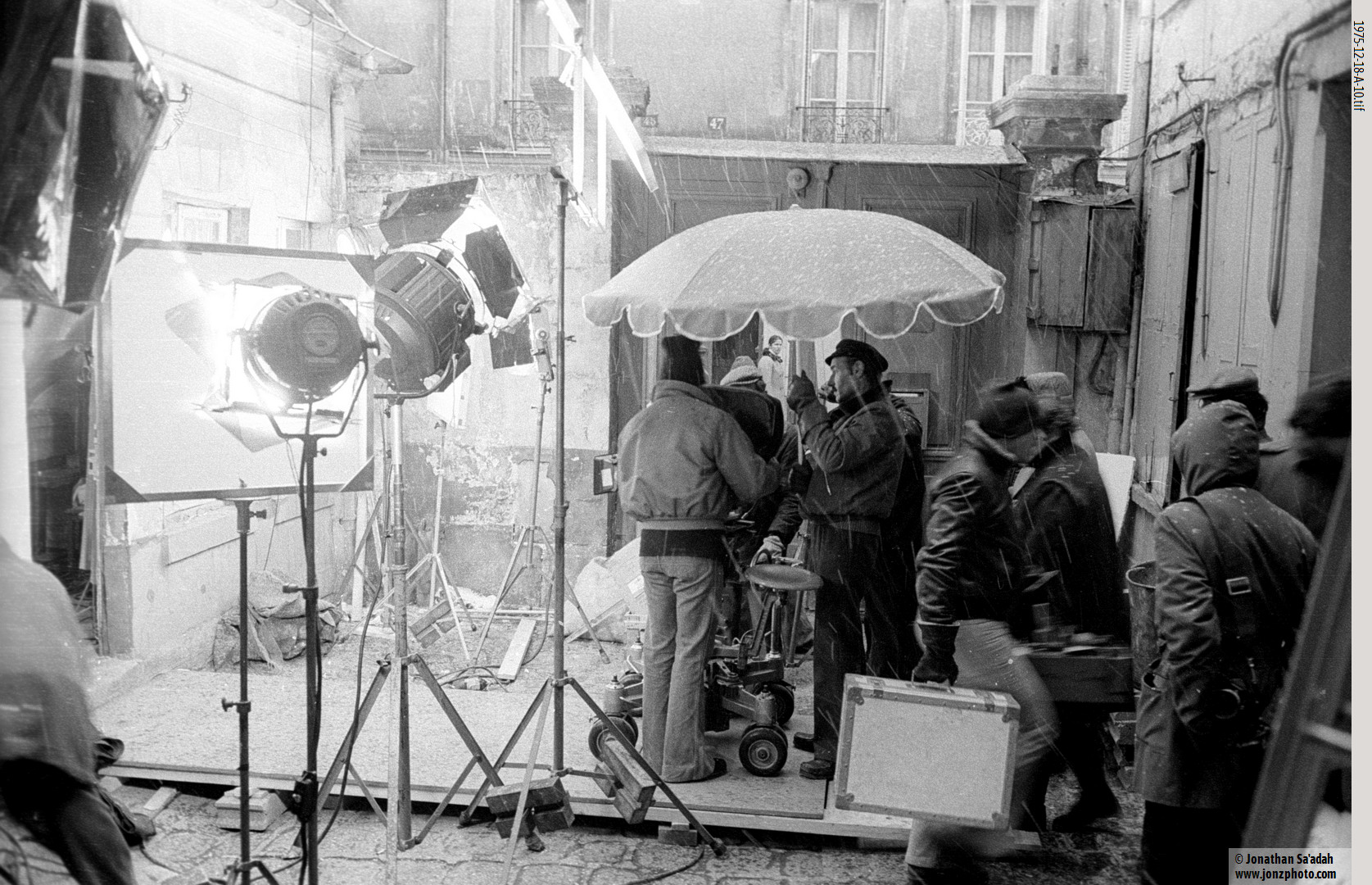
    Then the snow started. It hardly ever snows in Paris, but nature chose that morning. There was nothing to do other than protect the equipment and reschedule.

    Problems of location shooting
    Vicissitudes of location shooting Work to set up for the shot had started at 6am. Actors were in their dressing trailers prepared to go. Everyone was ready to start shooting, and then the snow started …

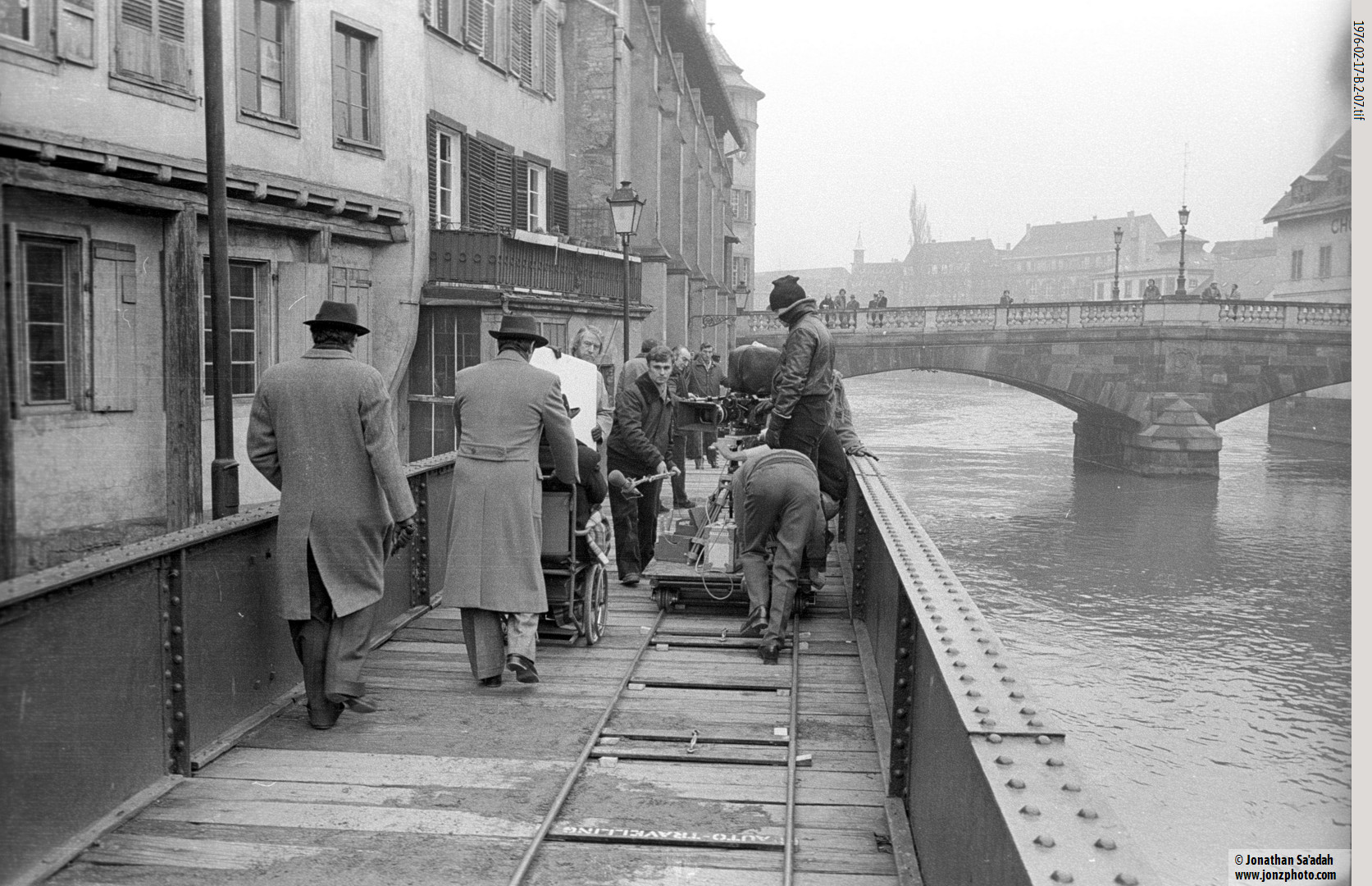
    Another location which, atypically, wasn’t in Paris but didn’t work out smoothly either was in Strasbourg and was used for the shots along the canal. On arrival in Strasbourg Losey had a serious asthma attack and was not well, adding to the stress.

    The location along the canal had been scouted in advance, but someone overlooked that tracking shots were called for. The underfoot surfaces were rough – brick cobblestones and a wooden walkway – making any movement of the camera a challenge, much less the fluid moves Losey expected.

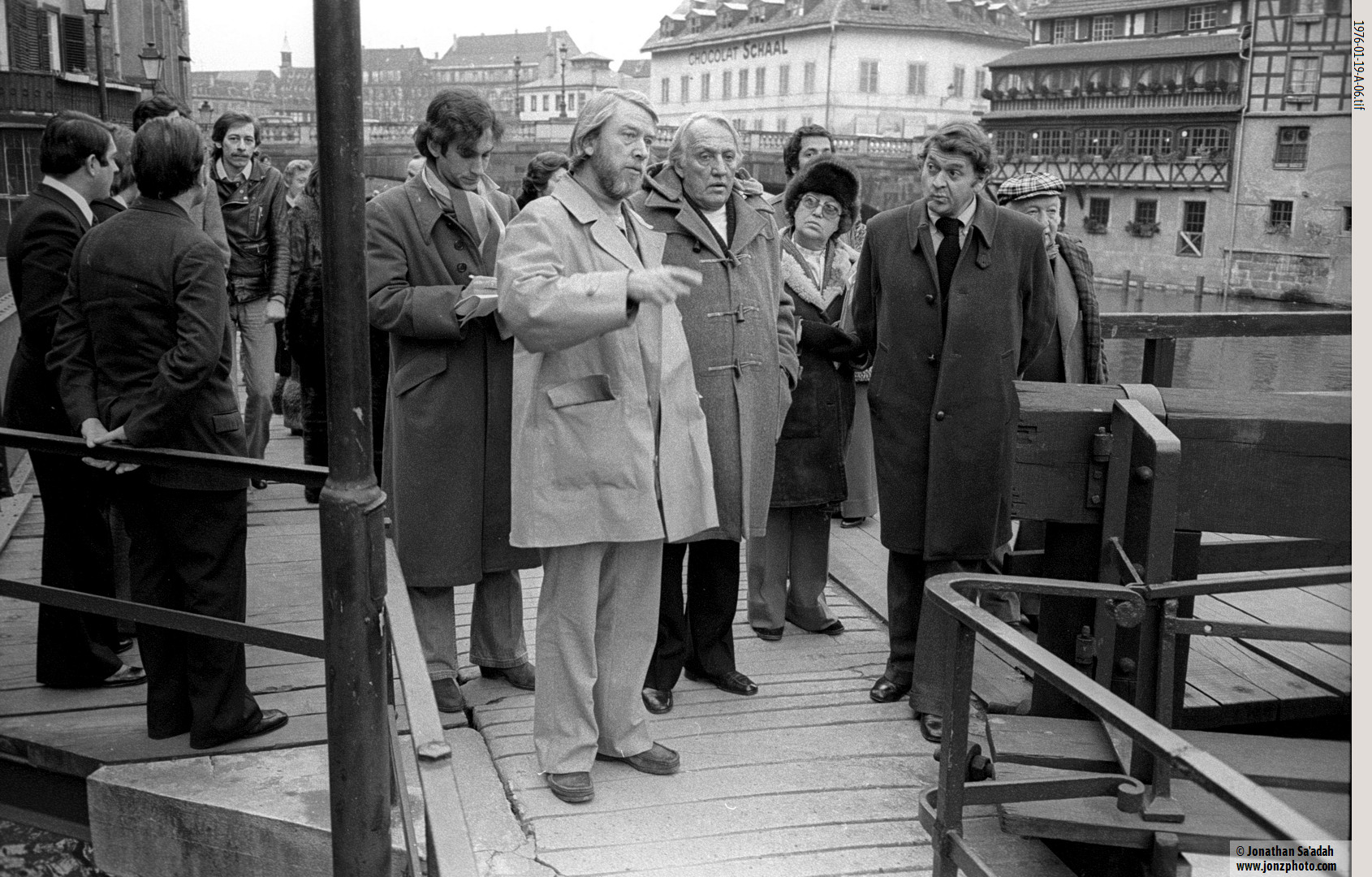
    ▲ Losey arriving at the location in Strasbourg and being informed of major problems by Gerry Fisher, Director of Photography. The man reacting on the right next to Losey is his First Assistant Director, Phillipe Monnier and just behind him is Alexandre Trauner, who was probably the person who had signed off on the location. The man taking notes is an assistant director, and Lucie Lichtig (in the Russian hat, Continuity) is watching Losey to see gauge if he’ll explode. It was not a happy moment.
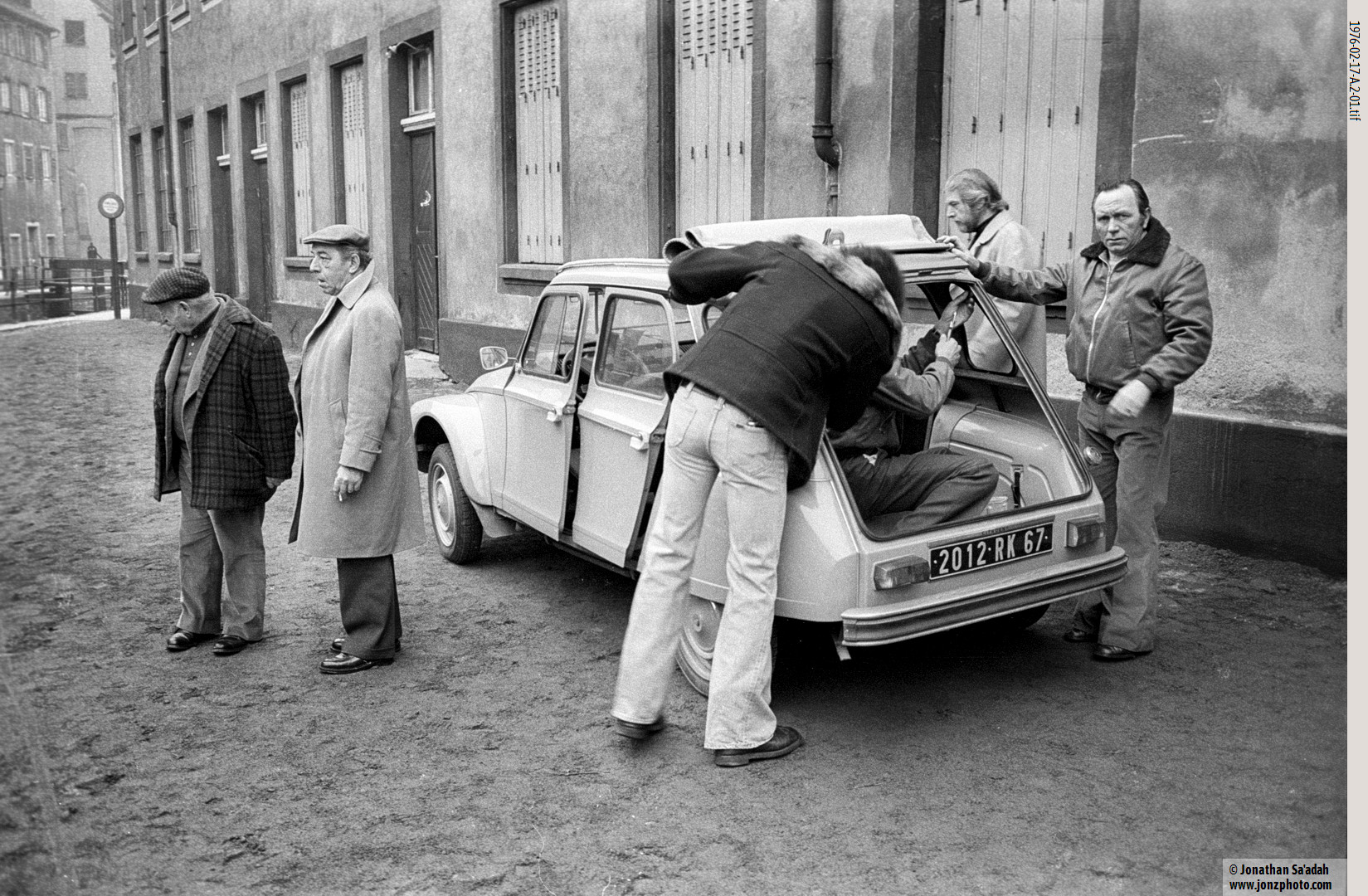
    ▲ Sand has been spread over the bumpy brick surface and a quickly-requisitioned Deux Chevaux is being hastily stripped so the camera can be mounted through the sunroof. Charles Lefèvre, the Chief Electrician, is glaring at me, registering his opinion that this level of disaster didn’t need to be photographed. Alexandre Trauner, the Art Director, on the left with his assistant, is hoping the newly spread sand will work to smooth out the surface and save the shot.

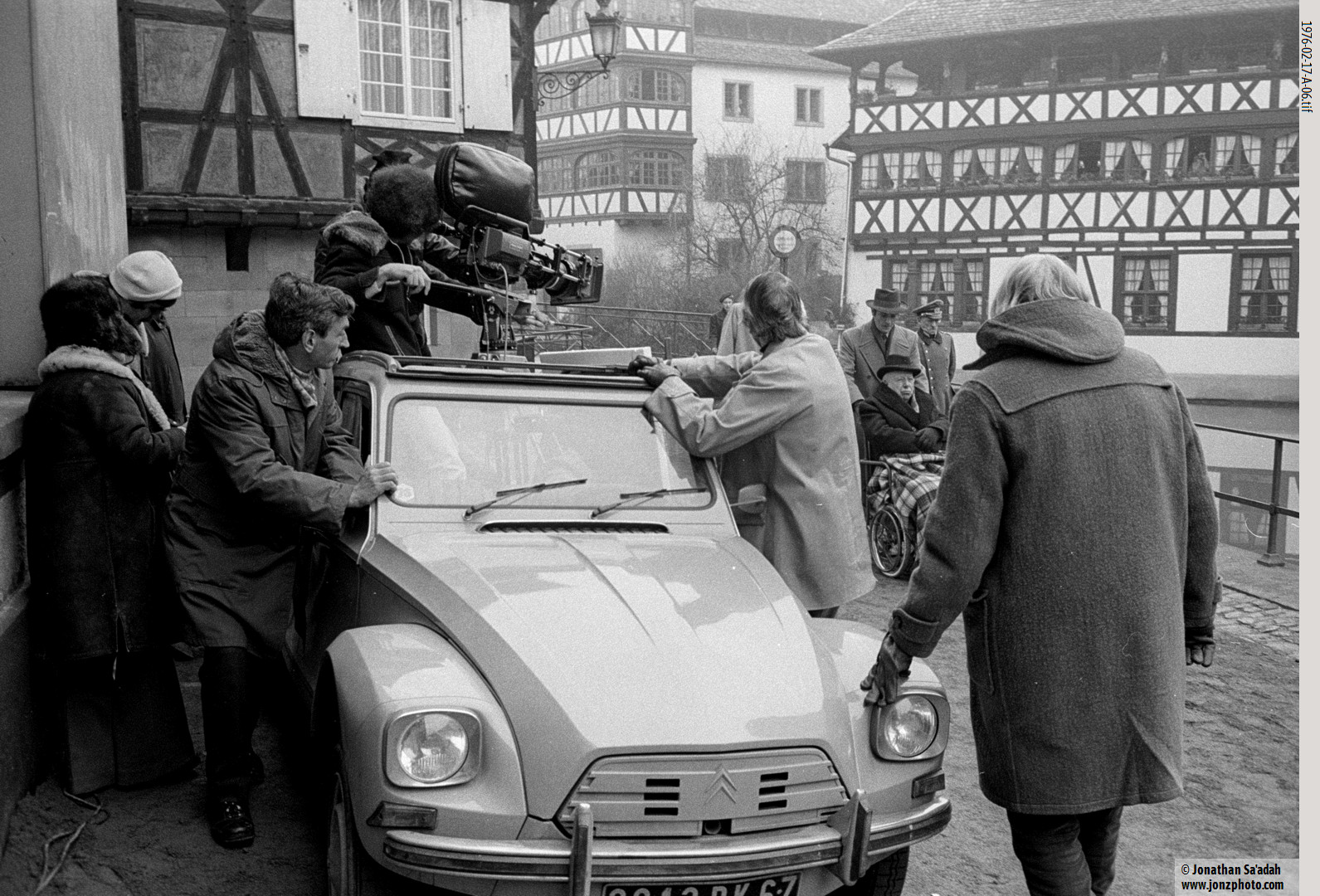
    This was a serious problem because the clock was ticking – it had already cost a lot to move the whole production to Strasbourg and the shots needed to go off according the schedule. Everyone was under the gun. The machinists rigged up a hastily modified soft-tired Citroën Deux Chevaux with the Panavision camera on a tripod, tightly lashed to its floor. This whole rig was pushed by human-power but only after the bricks were wiped with sand to smooth them out a bit (which introduced its own problems).

    ▲ The first sequence is being shot. The Panavision camera has been mounted on the Deux Chevaux which is being pushed by hand. Klein powers his father through the sand in the wheelchair while Losey (back to camera, right) watches the shot.

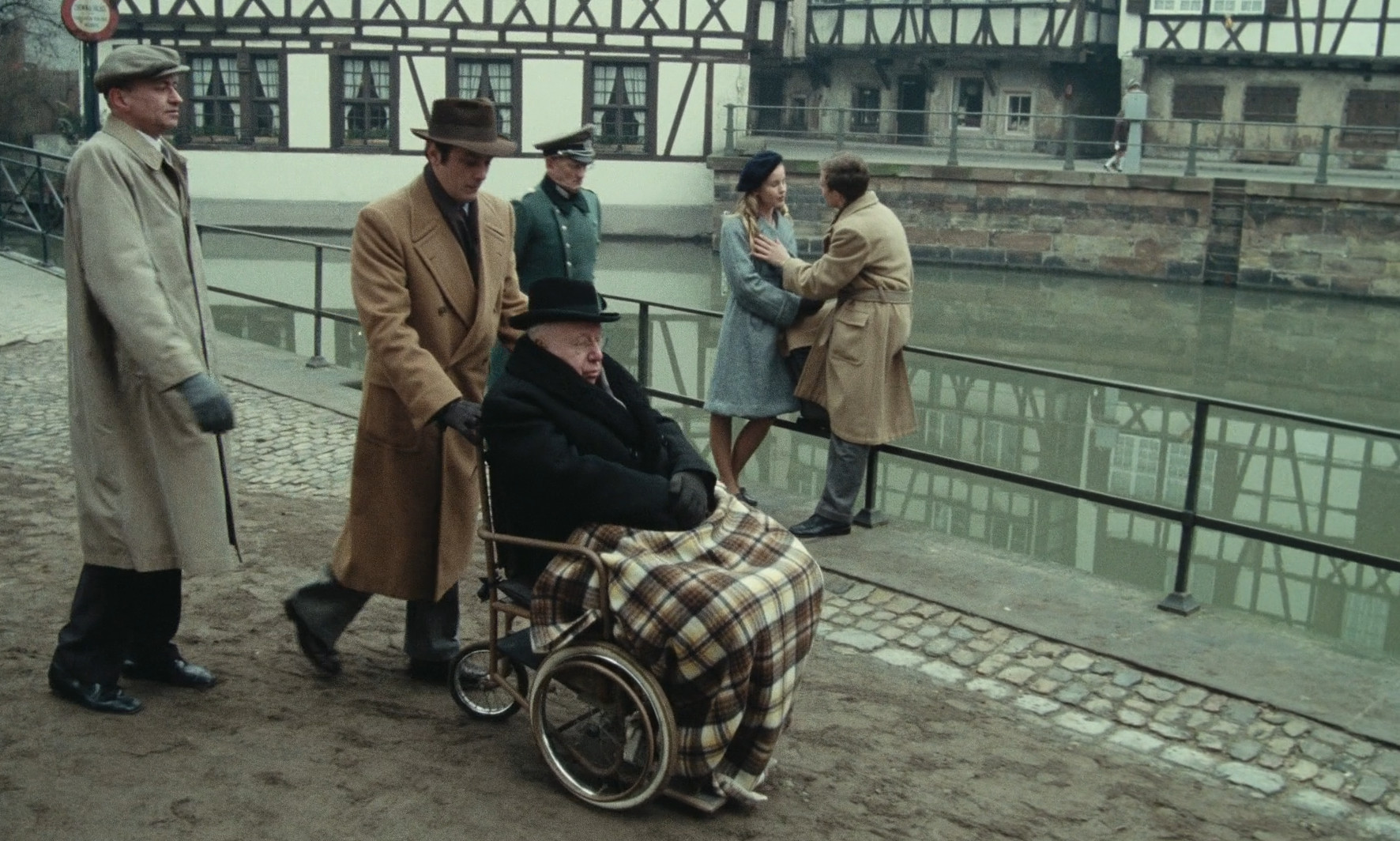
    It was also problematic that Klein’s father was in a wheelchair and at the beginning of the shot his caretaker had to push him while he spoke, with Robert Klein taking over partway through. In the resulting shot it’s obvious that sand has been spread around (it looks out of place) and there are a lot of wobbles in the movement of the wheelchair (and the car-mounted camera). Luckily, the actor playing the caretaker and then Delon, after he took over, were strong enough to get a marginally acceptable result.

    ▲ Klein taking over from his father’s caretaker (left) and pushing the wheelchair through the sand in a frame taken from the movie (Ⓒ Lira Films – Nova Films).

    In the next shot (on the problematic wooden walkway) the Deux Chevaux was used for the establishing shot with Klein’s body screening view of the sand that had been spread to even the walkway. The next shot, a side closeup, is a long tracking (rail) shot. Again, Delon had the challenge of pushing his father on slats that had been leveled as much as possible with sand, trying to power through and disguise the problem. A true professional, Delon was strong enough to concentrate on his role without appearing the least bit rattled.

    ▲ Track has been laid down for the camera, and sand on the boards to try and even things out when pushing the wheelchair. This setup worked better than the Deux Chevaux, and was more traditional as well.

    Each location had its problems, some less than others but some more too. The complicated and costly stadium scene at the end of the film was so difficult that the filming broke down towards the end of the day, and the editor had to work to salvage what he could. But overall the use of locations did a lot to make M Klein echo the time and events it was portraying, and to enhance and reinforce the reputation of the film.

    Other posts in this series about M Klein: Joseph Losey’s film M Klein: A behind-the-scenes look

    Locations arranged by date

    Name of sceneLocationAddressFilming date
    Titles
    Cabinet du professeur Montandon et Salle d’attente & couloirsHôpital Cousin de Mericourt & Besson15, av Cousin de Méricourt 242230 Cachan1-Dec-75
    Chambre/Salle de bainsStudios de Boulogne2, rue de Silly, Boulogne (Plateau A)3-Dec-75
    Appartement Robert KleinStudios de Boulogne2, rue de Silly, Boulogne (Plateau A)4-Dec-75
    Appartement Robert Klein – ChambreStudios de Boulogne2, rue de Silly, Boulogne (Plateau A)5-Dec-75
    Appartement Robert Klein – Rez-de-chausseeStudios de Boulogne2, rue de Silly, Boulogne (Plateau A)5-Dec-75
    Repetition du spectacle Frantz SalieriStudio Constant13, boulevard de Clichy6-Dec-75
    Repetition du spectacle Frantz SalieriStudio Constant13, boulevard de Clichy8-Dec-75
    Salle des ventesHotel Intercontinental3, rue de Castilglione8-Dec-75
    Boite de nuiteCabaret: “La Nouvelle Eve”25, rue Fontaine9-Dec-75
    Boite de nuiteCabaret: “La Nouvelle Eve”25, rue Fontaine10-Dec-75
    Coulisses theatreCoulisses Theatre25, rue Fontaine11-Dec-75
    Administration du journalImprimerie C.I.B.7, rue Darboy 7500112-Dec-75
    Rue de Paris, vers 2éme KleinRue de ParisRue Gasnier Guy12-Dec-75
    Rue de Paris minutageRue de ParisRue Lepic (à l’angle de la rue de Lorient)15-Dec-75
    Bistrot TelephoneCafé “Au Réveil Matin”23 rue Chanzy15-Dec-75
    Appartement Robert KleinStudios de Boulogne2, rue de Silly, Boulogne (Plateau A)16-Dec-75
    PhotographeStudios de Boulogne2, rue de Silly, Boulogne (Plateau A)16-Dec-75
    Façade maison 2ème KleinFaçade Maison 2ème Klein42 rue des Panoyaux17-Dec-75
    Loge ConciergeLoge Concierge42 rue des Panoyaux17-Dec-75
    Maison 2ème KleinMaison 2ème Klein42 rue des Panoyaux18-Dec-75
    Maison 2ème KleinMaison 2ème Klein42 rue des Panoyaux18-Dec-75
    Rue maison 2ème KleinMaison 2ème Klein42 rue des Panoyaux19-Dec-75
    Cour & loge maison 2ème KleinCour & loge maison 2ème Klein42 rue des Panoyaux19-Dec-75
    Appartement 2ème Robert KleinAppartement 2ème Klein42 rue des Panoyaux19-Dec-75
    Lycée Henri IV Lycée Henri IV23 rue Clovis22-Dec-75
    Rue immeuble 2ème KleinRue immeuble 2ème Klein42, rue des Panoyaux22-Dec-75
    Cour maison Robert KleinRue du Bac110 rue du Bac23-Dec-75
    Cour maison Robert KleinRue du Bac110 rue du Bac23-Dec-75
    Cour maison Robert KleinRue du Bac110 rue du Bac23-Dec-75
    Cour maison Robert KleinRue du Bac110 rue du Bac23-Dec-75
    Cour maison Robert KleinRue du Bac110 rue du Bac24-Dec-75
    Cour maison Robert KleinRue du Bac110 rue du Bac24-Dec-75
    Appartement Robert KleinStudios de Boulogne2, rue de Silly, Boulogne (Plateau A)29-Dec-75
    Appartement Robert KleinStudios de Boulogne2, rue de Silly, Boulogne (Plateau A)30-Dec-75
    Appartement Robert KleinStudios de Boulogne2, rue de Silly, Boulogne (Plateau A)30-Dec-75
    Appartement Robert KleinStudios de Boulogne2, rue de Silly, Boulogne (Plateau A)31-Dec-75
    Appartement Robert KleinStudios de Boulogne2, rue de Silly, Boulogne (Plateau A)31-Dec-75
    Appartement Robert KleinStudios de Boulogne2, rue de Silly, Boulogne (Plateau A)5-Jan-76
    Appartement Robert KleinStudios de Boulogne2, rue de Silly, Boulogne (Plateau A)5-Jan-76
    Appartement Robert KleinStudios de Boulogne2, rue de Silly, Boulogne (Plateau A)5-Jan-76
    Appartement Robert KleinStudios de Boulogne2, rue de Silly, Boulogne (Plateau A)5-Jan-76
    Appartement Robert KleinStudios de Boulogne2, rue de Silly, Boulogne (Plateau A)6-Jan-76
    Prefecture, salle de reunionStudios de Boulogne2, rue de Silly, Boulogne (Plateau A)6-Jan-76
    Bureau FonctionnaireStudios de Boulogne2, rue de Silly, Boulogne (Plateau A)6-Jan-76
    Répétition séquence Usine stage CStudios de Boulogne2, rue de Silly, Boulogne (Plateau A)7-Jan-76
    Boulevard Minutage (Exterieur)Pont St-LouisPont St-Louis, angle quai d’Orlean7-Jan-76
    Prefecture-Tri Stage AStudios de Boulogne2, rue de Silly, Boulogne (Plateau A)7-Jan-76
    UsineUsine CitroënAngle Quai André Citroën et rue Leblanc8-Jan-76
    DepotCaserne des pompiers1, Place Jules Renard9-Jan-76
    MetroMetro1, Place Balard9-Jan-76
    La CoupoleLa Coupole102, bld du Montparnasse12-Jan-76
    Appartement Robert KleinStudios de Boulogne2, rue de Silly, Boulogne (Plateau A)13-Jan-76
    Morgue Stage C Studios de Boulogne2, rue de Silly, Boulogne 13-Jan-76
    Retake “Tapisserie”Studios de Boulogne2, rue de Silly, Boulogne (Plateau A)13-Jan-76
    EgliseEglise Saint-EustacheAngle rue Montmartre et rue Coquillère14-Jan-75
    Journee de voyage Paris/Strasboug15-Jan-76
    Jardin PublicStrasbourgLe Bord de L’Ill (Place Benjamin Zix)16-Jan-76
    Gare Ivry la BatailleGare de Mortcerf 7722019-Jan-75
    Quai gareGare D’AusterlitzQuai gare20-Jan-76
    Train en marcheGare D’AusterlitzVoie 21 Gare D’Austerlitz21-Jan-76
    No call sheet, shooting cancelled22-Jan-76
    Police car depotGrand PalaisGrand Palais22-Jan-76
    Maison PierreRue St-Dominiquec/o M Netter, 11 bis, rue St-Dominique23-Jan-76
    KiosqueRue du Bac110 rue du Bac26-Jan-76
    Morgue Stage AStudios de Boulogne2, rue de Silly, Boulogne26-Jan-76
    Scouting Château d’EsclimontChâteau26-Jan-76
    Stade“La Cipale” (Vélodrome Municipal de Vincennes)Avenue de Gravelle Paris 1228-Jan-76
    Stade“La Cipale” (Vélodrome Municipal de Vincennes)Avenue de Gravelle Paris 1229-Jan-76
    MinutagePlace Lucien Herr 5ème30-Jan-76
    Int. autobus en marcheAutobus68, rue Coriolis (12ème)30-Jan-76
    Eventuellement, décor: Retakes tapisserieStudios de Boulogne2, rue de Silly, Boulogne (Plateau A)30-Jan-76
    Wagons fin de filmGabriel Lamé1 rue Gabriel Lamé31-Jan-76
  • All roads? Perhaps not …

    I’ve never been totally comfortable with Rome. To be honest, I’ve always had problems with authority and authority figures, and there’s no city more populated with both than the old Roman capital. And that’s not even saying anything about the Vatican. I can be relatively sure that my ancestors paid a price to the Romans, and it makes the hair on the back of my neck stand on end when I walk down the present-day beautiful and elegantly-appointed streets and see the wealth and power that’s the product of that price.

    On the other hand, the world has moved on, and I have too. I’ve always been attracted to temperate zone cultures, and Italy is no exception. But all my previous experiences were in the northern tier of the country, especially in the Veneto (Padua, Vicenza, Venice).

    So Rome was a new experience for me. I’ve posted a ⊕portfolio of photographs of the city. The old part of Rome is really set up to be a tourist magnet. As such, it certainly doesn’t let one down. There is a casual, un-curated feeling that makes being there a pleasure. Overlaying the old is the modern jumble of chaos that passes for Italy, complete with savory and unsavory overtones. I am always trying to scratch under the surface and see what I find, and I found a lot.  I have no blood history with Italy but it’s easy to see the racism, the governmental chaos, and excesses along with the society’s appreciation for living life and the long and real investments in art and culture. In short, it’s a fun place to be as a person and a photographer who doesn’t have to live there, and has the privilege of being able to dip in and out.