Category: Artists

  • In search of Auxilio Lacouture

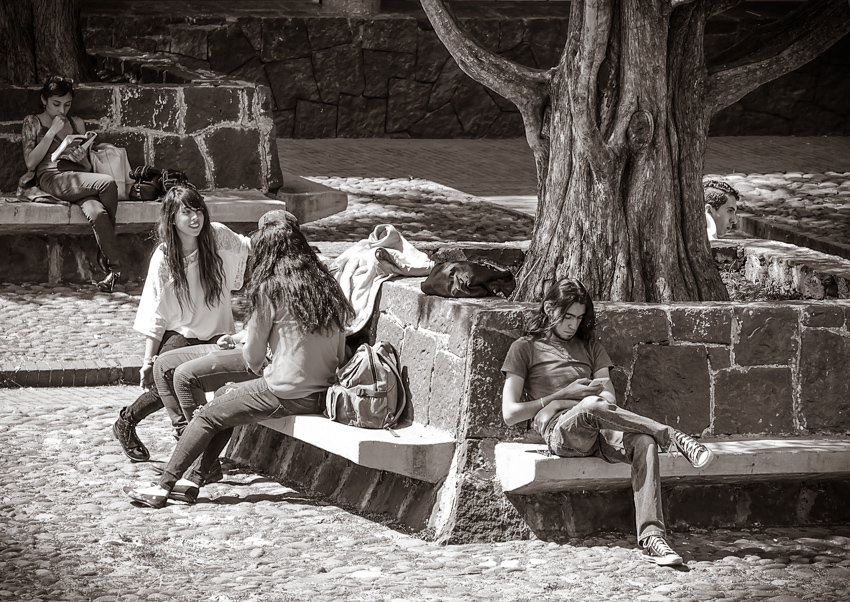
    Students reading and talking  In the southern part of Mexico City, the Universidad Nacional Autónoma de México (UNAM) is a 425,000 student campus with many departments. Its graduates form a backbone of recent Mexican history. The current campus replaced a metropolitan location in the 1950s, but the school traces its lineage back to 1551.

    I’m not as big a recreational reader as I’d like to be. I’m not that fast a reader and I feel like after I’ve waded through all the web and print articles and news reports I’m interested in there isn’t a lot of extra time left over. But before going to Mexico City I set a goal of reading several books about the city and Mexico, and one of them was Savage Detectives by Roberto Bolaño. I have a hard time understanding why this book isn’t generally known and acknowledged to be one of the great novels of the 20th century. Bolaño, a Chilean who lived mostly in Mexico City and Barcelona, was an enfant terrible of the literary world and a complicated, evocative writer. I haven’t read his masterpiece 2666 yet, but I’m looking forward to it.
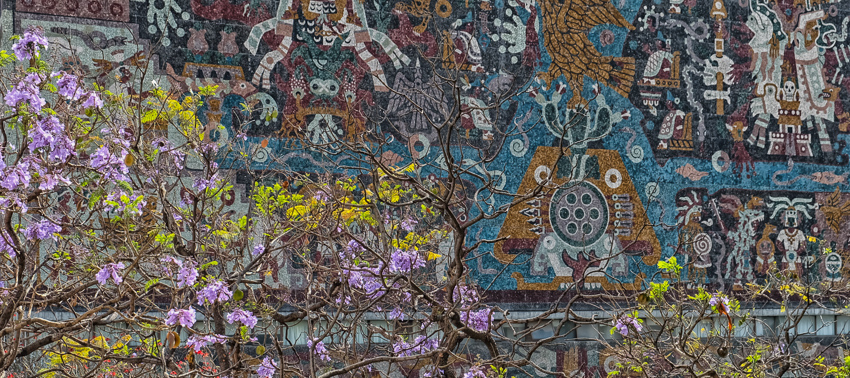
    The outside surfaces of the university library are covered with a wrap-around mural by Juan O’Gorman depicting different periods of Mexican history. The generally huge scale of the campus is home to other building-sized murals.

    Savage Detectives is mostly set in Mexico City and strings together a story of a group of young scruffy Mexican poets searching for a woman (Cesárea Tinajero) who had disappeared from the city several decades before. They considered her to be the mother of Visceral Realism, their faction of the Mexican poetry world. In a complex weave the story line touches many subplots, and one of them involves a character who is a Uruguayan female poet and teacher named Auxilio Lacouture.

    Auxilio Lacouture taught at the Universidad Nacional Autónoma de México (UNAM) for several years. According to her own narrative, she was not quite sure what those years were, but one event fixes her as being there in 1968. That event was the Mexican army and riot police killing an unknown number of students in Tlatelolco, a section of Mexico City. A sadly familiar story having a contemporary ring.
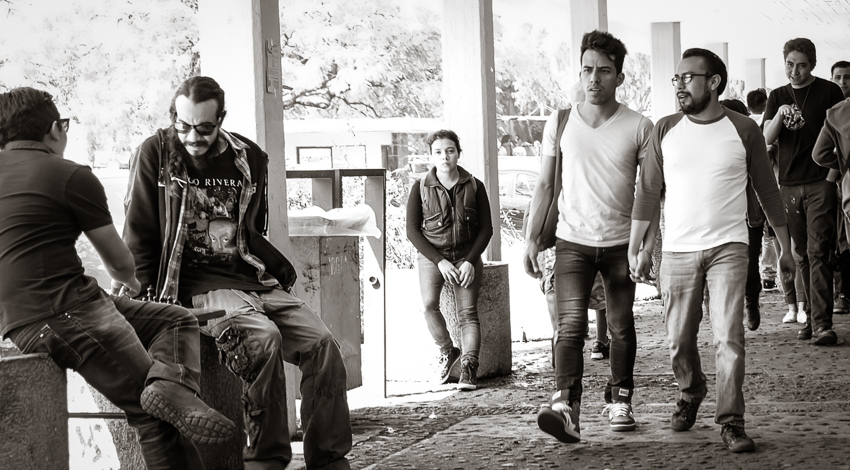
    UNAM students on lunch break.

    Subsequently, the Army occupied UNAM.

    Auxilio Lacouture had the distinction of spending thirteen days in September of 1968 shut up in the women’s bathroom on the fourth floor of the Faculty of Philosophy and Literature as a protest against the Army’s occupation of the campus. She had been reading a book of poetry of Pedro Garfías in a toilet stall and simply stayed there undiscovered – alone and stubborn – standing up (or sitting down!) against tanks and militarism until they left thirteen days later.

    I thought it would be interesting to go to UNAM and see if I could find the her fourth floor perch. I was also interested because our friend, Magda, had gone to Medical School there and I wanted to see where she had spent that time.
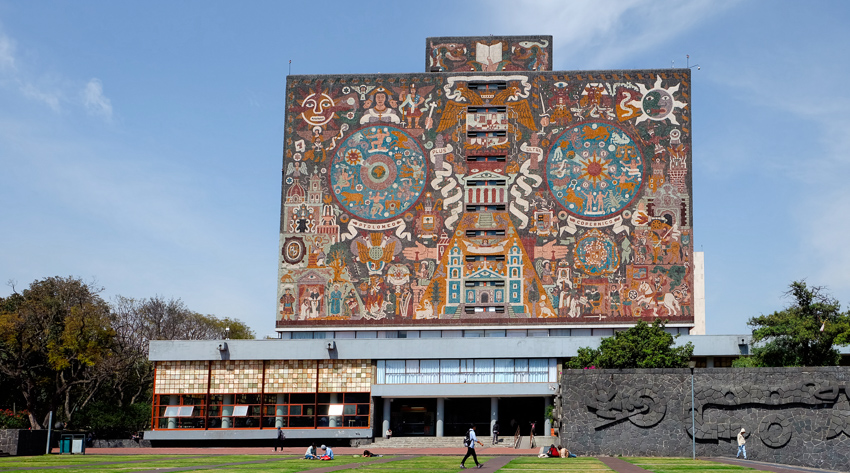
    A more conventional look at the unconventional exterior of the central university library. The mural wraps around all four sides.

    UNAM is a huge campus – there are almost 400,000 students. To be a student there involves a lot of competition and carries prestige. UNAM reflects both a tradition of academic freedom and social activism that seems part of Mexico.

    The feeling on campus was not especially comfortable for me. It was obvious that I was an outsider, as well as being several decades older than almost everyone we saw.

    We tracked down the building and floor that Auxilio had been in. A narrow staircase led to the fourth floor. A small – almost claustrophobic – hallway formed a central corridor with many closed wooden doors. The interesting fact was that no one save one student had heard of Roberto Bolaño, and on the subject of Auxilio Lacouture – a complete blank. We found a locked women’s bathroom, but the closest we got to Auxilio’s memory were raised eyebrows as an adult staff member and secretary Googled her. A picture of me outside the bathroom was on the phone stolen later in the day on the Metrobus. It really doesn’t matter to me that Auxilio Lacouture never actually existed. She was fashioned after a real person who was at UNAM (Alcira Soust Scaffo), herself a Uruguayan poet. Considering the position of both Bolaño as a writer and Savages as a book, there should have been no hesitation recognizing him as a writer and Lacouture as a character …

    I’m not sure what all of this says. A friend in Montreal who is from South America said it’s typical in Columbia, where she grew up, for the government to eradicate memory. This may be an example of that same phenomena in Mexico.

    Sometimes, I have to admit, I feel the same way about the 1960s here.
     

  • Fretting about Uber

    I bought a shiny new camera last week. It weighs 180 grams, about a half the weight of my old Leica M4. For 29 years the Leica snuggled happily under my shoulder. Since 2002 – when I gave up using it – I’ve had a mottled succession of computer-cameras, their lifetimes proportional to their cost and the associated guilt factor in replacing them. My feelings towards them has been a shrug – grateful for what they do but indifferent to the cameras themselves.

    It’s different with this new camera. It’s small and it does a lot. It costs about the same as a mid-level phone, and includes apps that connect to various social networks. It doesn’t exactly think for you, but it certainly tries.

    I’ve been having a bit of high-level identity crises as a photographer for the last couple of years. It’s pretty understandable really. Making a photograph has gone from being a fairly complicated endeavour connoting a certain level of skill to something that the average cell phone does quite well (unaided). What that means is that the pool of capable photographers has gone from a relatively small number to a few billion. I’m not sure of the number, but it’s big. It’s no wonder that I feel a little insecure.

    Actually, I think that insecurity started in the 1990s. It wasn’t that everyone could make pictures easily then, but rather that work-for-hire agreements started showing up as part of doing business in the photography world. I had been earning a living as a photographer from the mid-1970s through the 1980s, and work-for-hire was a new arrangement. The bottom line was that a freelancer, such as a photographer, suddenly got designated as an “employee” of a company and the company henceforth owned whatever you produced for them. It was a good deal for the company, and a crappy deal for the photographer. Also there was the rise of “stock agencies” – libraries of images that were either under corporate ownership or corporate management, and basically bypassed meaningful compensation for the photographer who created them.

    In basic terms, artists were not getting paid reasonably and the supply of images was ballooning to where, for a small fee, a buyer could get a picture that replaced what previously was a job for the freelancer. In that transition period not only were freelancers getting screwed, but they were also getting replaced.

    Enter Napster. Sort of the grandfather of torrenting, Napster made it possible for copyrighted music to be “shared” with no compensation to the artist at all. Suddenly it didn’t matter if you were the Berlin Philharmonic or a garage band in Santa Barbara – your music was no longer under your control and you could confidently look forward to a future of cold-water flats and low-end gigs if being a musician was a high priority to you.

    Ditto for photographers. Suddenly (in the early 2000s) photos of mine started showing up in the oddest of places. A portrait that I did of a couple of friends popped up unannounced in Europe illustrating a medical journal article on chemotherapy, where one of my friend’s relatives saw it and called in tears sure that something terrible was going on. Well meaning people pushed the limits of what was (is) called “fair use” to include just about anything. The number of photographers making a living, which had never been a bed of roses, got fewer and the challenges got harder. People who were stubborn and highly talented ended falling down the chain, going from being able to work on challenging projects requiring active minds to mind-numbing work servicing low-margin accounts.

    Montreal, like a lot of cities, has been hearing a lot of noise recently over Uber. I keep on booting the Uber app and looking at in in my phone. It’s cool, with all those cute Packman-esque cars cruising around. The truth is that I’ve only ordered a cab in this city a couple of times and then always by (voice) phone, but I keep on cycling through these imaginary scenarios where I’m in another city, say New York or Mexico City, and with a single screen tap a driver shows up to ferry me to some destination. In Mexico City, especially, that’s an enticing prospect. Choose the wrong cab there and you can get treated to an extended ride sandwiched between two thugs making ATM-draining stops. In that context Uber looks like an attractive safety-policy. To be balanced, it’s fair to say, by smashed windshields and the violent opposition of the traditional taxi drivers who are more than a little upset at being replaced, and the same in Montreal.

    To me, all the angst over Uber sounds quite familiar, and I’m not really sure how deep my sympathies go. I felt like I got screwed a long time ago, so why should I get all excited about taxi drivers?

    But that doesn’t necessarily help with the identity crises. There’s a general theory that as the supply increases, the perceived value goes down. I can easily go to IKEA and buy what looks like a fairly good rendition of a Paul Strand hand-pulled gravure photo for what – maybe $20 for a pack of three. Why should someone plunk down more than that for some image that I’ve made? It’s a good question, and that’s been ominously answered in the art market that’s broken into two segments – one where art is “worth” crazy-high valuations and the other where it’s worth, well, not so much.

    But getting back to my new camera. I used to buy huge, expensive professional cameras until it dawned on me that actually the Leica had worked a whole lot better and facilitated what I liked doing – making pictures – much more successfully than the latest multi-thousand dollar behemoth that darkened the sky and stopped all conversation as soon as it appeared in the room. To say nothing about causing arthritic shoulders from carrying it around. So the consumerism of the latest fancy gadget – part of what sucks money away from people feeling like they can afford to buy art – is also being fed by me. It also does a pretty good job of replacing my skill sets for a few bucks. But, in this case, something funny has happened. This camera, a small fraction of what “pro” models cost, is actually similar to the Leica and so it’s like things have come back in a circle to where pictures are actually fun to create again and an opaque hunk of metal isn’t becoming a barrier wall to where I’m trying to go.

    It has been almost two decades getting there…

  • Minor White

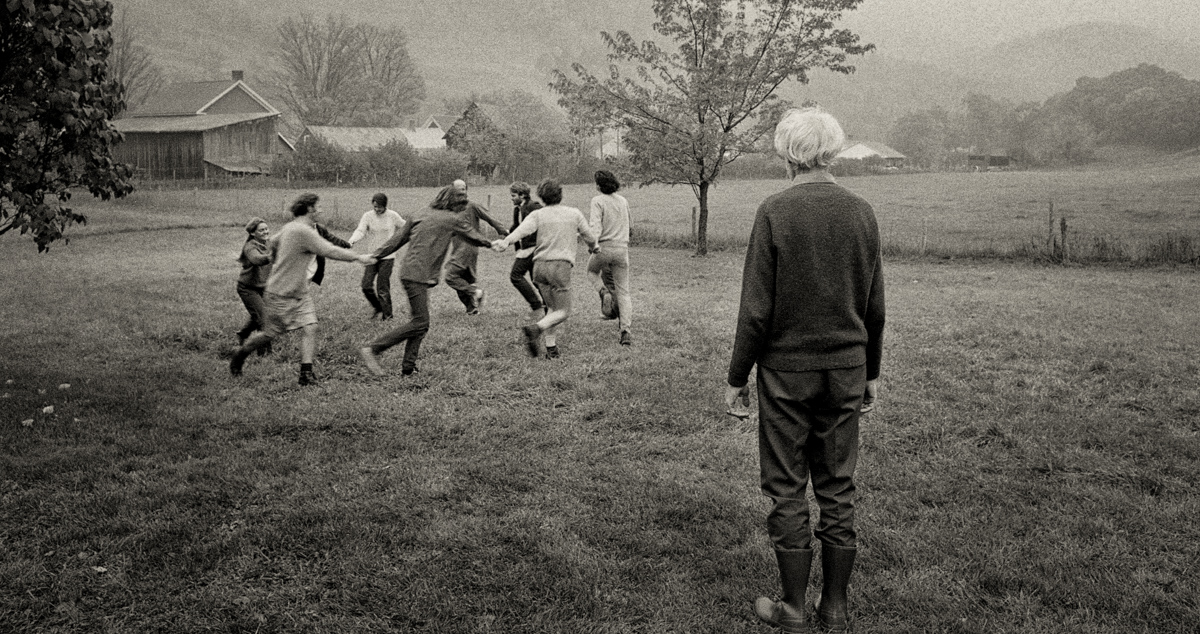
    South Pomfret, Vermont, 1970
    South Pomfret, Vermont, 1970

    From Fall, 1970 through the following June I was a student of Minor White’s. Though I was chronologically an undergraduate he placed me in his graduate program. It’s people from that class that you see in the circle above.

    If history is written by victors it also contains a good measure of current social mores. I was pleased to be sent a link to this recent essay by Susan Stamberg. White died almost thirty years ago. The essay has candor and judgement in its measurement of the man, who I knew only in the context of school and a few extended workshops. But I think there is a poignancy in this photo that’s correct.

    I’m also attached to the photo for a personal reason. If you look closely there is a hill hiding in the background fog. It is a small ski area in Vermont called “Suicide-Six”, which was the local ski hill when I was young. So seeing it always makes me smile.